


Whenever someone used to ask me what I did, I had a list.
Artist. Entrepreneur. Marketer. Writer. CEO. Educator. Worldbuilder.
All of those answers were true. The problem was that the longer the list became, the less useful it was. Every time I learned how to do something new, I seemed to need another label to explain it. Eventually, telling someone what I did started sounding less like I was describing one person’s work and more like I was introducing a small creative department.
For a while, I thought I just hadn’t found the right category yet. Maybe one discipline was supposed to sit above everything else. Maybe I was an artist who happened to build companies, or an entrepreneur who happened to write. Maybe the essays, paintings, business systems, fictional worlds, courses, and frameworks were separate branches that needed one sufficiently clever title above them.
But that never really matched how the work felt from inside it.
From the outside, it could look fragmented. To me, it felt strangely continuous. I could spend one day thinking about how a company acquires and retains customers, another developing the mythology of a fictional civilization, another writing about creative sovereignty, and another working through the architecture of a painting. The mediums changed. The subjects changed. Sometimes even the audience changed.
But underneath all of it, I kept running into the same kinds of questions.
How do people become more capable? What makes a system endure? What should we own? How does identity shape what we create? What happens when technology changes who gets to participate? How do you build something that compounds instead of disappearing?
Eventually, I started wondering if I’d been looking for coherence in the wrong place.
I was looking at the outputs.
A painting could tell me I was an artist. A company could tell me I was an entrepreneur. An essay could make me a writer. A course could make me an educator. But none of those labels explained why the same ideas kept showing up across work that looked completely different on the surface.
What interested me was that I could change the medium without necessarily changing the thinking behind it.
The continuity seemed to exist somewhere further upstream, in what I noticed, the patterns I kept connecting, the questions I thought were worth pursuing, the things I rejected, the things I valued, and even the conclusions I eventually changed my mind about.
Once I started seeing my work that way, figuring out what to call myself became a lot less interesting.
A better question appeared.
What remains yours when the medium keeps changing?
That question would’ve been useful to me at almost any point in my creative life. But now I think it’s becoming relevant to a much larger conversation, because the mediums aren’t the only things changing.
So is the difficulty of making something with them.
Writing. Imagery. Video. Software. Research. Design. Music. Analysis. Generative systems are making parts of these activities increasingly accessible, allowing people to produce work faster and perform tasks that previously demanded more specialized expertise.
And that creates an interesting problem.
If more people can produce competent work using increasingly capable tools, simply being able to make something tells us less about why anyone should choose what you’ve made. The ability to produce still matters, but it may no longer provide the same advantage it once did.
I’ve been thinking about what happens when the tools themselves become less useful as a way of distinguishing one creator from another. Two people can have access to the same technology, the same information, and many of the same productive capabilities, yet make completely different things with them.
One recognizes an opportunity the other overlooks. One accepts a perfectly competent result while the other rejects it. One connects ideas from seemingly unrelated disciplines and discovers something neither discipline would’ve revealed on its own.
What’s actually creating the difference?
That’s the question I want to explore, because I think it changes how we should understand creative advantage.
We’re going to look at how production became a source of differentiation in the first place, what happens as technology makes those capabilities more accessible, and why generating more possibilities creates an entirely different problem: deciding which possibilities deserve our attention.
But there’s another distinction I want to make along the way. Having a recognizable personality, a distinctive style, or strong opinions isn’t necessarily the same thing as developing a point of view. And as machines become increasingly capable of reproducing the things we make, that distinction becomes much more important.
By the end, I want to give you another way to think about what makes your work valuable, particularly when the tools you use are available to almost everyone else. It has less to do with finding something nobody can imitate and more to do with developing the knowledge, perception, taste, and judgment that shape what you choose to create in the first place.
That brings me back to my original problem.
Maybe the mistake wasn’t having too many disciplines. Maybe it was assuming that the discipline, the medium, or the finished work was where my creative identity ultimately lived.
And maybe the same assumption has shaped how we’ve understood creative advantage for a very long time.
For most of creative history, simply being able to make the thing was an advantage.
When Making the Thing Was the Advantage
For most of creative history, being able to make something well was not a widely distributed capability.
A photographer needed more than an eye. They needed a camera, film, processing equipment, technical knowledge, and somewhere to develop the images. A filmmaker needed cameras, lights, sound equipment, editors, crews, and eventually a way to distribute the finished work. A publisher needed printing infrastructure. A designer needed specialized tools and the training to use them. And if you wanted to build software, knowing what it should do wasn’t particularly useful if you couldn’t write the code required to make it work.
Production had friction.
There was a real barrier between having an idea and turning it into something another person could experience. Even writing, which has always had a relatively low material cost, ran into another kind of scarcity once you wanted people to read what you’d written. You could write the manuscript yourself. But getting it edited, printed, distributed, stocked in bookstores, reviewed, or placed in a publication meant passing through systems most people didn’t control.
So the old advice made perfect sense.
Learn the craft. Master the tools. Get the credential. Gain access to the equipment. Become technically capable enough to do something most people couldn’t.
For a long time, getting better at production was one of the clearest ways to become more valuable. And I don’t think that suddenly stopped being true.
Craft still matters. Expertise still matters. Someone who’s spent twenty years learning how to see light isn’t interchangeable with someone who bought a camera yesterday. Generating a block of code isn’t the same as understanding the architecture of a complex software system. Producing a grammatically competent paragraph doesn’t make someone a great writer.
But here’s what I think we sometimes miss when we look back at that world.
Scarcity was doing some of the work.
When expensive equipment, specialized knowledge, institutional access, or years of technical training stood between an idea and its execution, fewer people could enter the field in the first place. Fewer still could produce at a professional level. That meant the ability to make the thing carried some differentiation before anyone even asked whether the thing itself was particularly interesting.
The barrier wasn’t only talent. It was access.
Then, piece by piece, we started removing that friction.
Desktop publishing moved capabilities once concentrated inside publishing houses onto personal computers. Digital cameras removed the need for film and chemical processing from most everyday photography. Nonlinear editing software brought increasingly sophisticated post-production onto personal computers. YouTube gave filmmakers and video creators a direct online distribution channel that didn’t require access to a television network. Social platforms gave writers, photographers, musicians, designers, educators, and eventually almost anyone with an internet connection new ways to publish directly to an audience.
Then the smartphone compressed even more of that infrastructure into something you could carry in your pocket: camera, recording device, editing tools, publishing interface, distribution channel.
None of this made expertise irrelevant. It made participation easier. And every time participation became easier, access became a little less useful as a source of differentiation.
You no longer necessarily needed a printing press to publish an idea, a television network to distribute a video, a recording studio to release music, or a gallery to show an image to thousands of people.
That doesn’t mean the gatekeepers disappeared. New ones emerged.
Platforms developed their own incentives, algorithms, economics, and forms of control. But something fundamental had still changed: the distance between I have an idea and I can make something from it had become dramatically shorter.
Generative AI accelerates that same movement, but here’s where things get interesting.
Previous waves of digital technology largely reduced friction around the creator. AI is increasingly reducing friction inside parts of the act of creation itself.
Someone who can’t draw can describe an image and receive one in seconds. Someone with limited programming experience can use generative systems to produce or modify functioning code. A blank page can become ten headlines, five outlines, three scripts, and a dozen alternative openings before you’ve finished your coffee. Someone with limited editing experience can increasingly describe the changes they want instead of manually performing every operation required to make them.
The capability doesn’t disappear.
Some of it moves into the tool.
And that changes the old equation.
If you couldn’t execute, an idea once had a good chance of remaining an idea. Now more of the distance between intention and execution can be crossed using capabilities you don’t personally possess at the same level as the system helping you.
That doesn’t make a novice an expert, make expertise obsolete, or turn everyone with a prompt into an artist, filmmaker, programmer, designer, or writer. It means something much simpler: more people can get something onto the page, onto the screen, and into the world.
For centuries, production itself helped decide who could participate. Now some of that filtering power is disappearing.
And that’s where the old map starts to break.
If access to production helped create differentiation, what happens when productive capability becomes increasingly accessible?
The answer isn’t that everyone becomes equally good.
Something more subtle happens.
The floor begins to rise.
The Floor Is Rising
The important change isn’t that everyone suddenly became equally talented. They didn’t.
It’s that portions of productive capability that once took significant time, training, or specialized knowledge to acquire can increasingly be borrowed from the machine.
We can already see this happening in the workplace. In a study of 5,179 customer-support agents, access to a generative AI assistant increased productivity, measured by issues resolved per hour, by 14 percent on average. But the more interesting result was where the largest gains occurred. Novice and lower-skilled workers improved substantially more, with gains of roughly 34 percent, while the most experienced and highly skilled workers saw minimal effects.
The system wasn’t turning novices into experts. It was helping them perform more like people who’d already learned things they hadn’t learned yet.
That’s an important distinction. The expertise still existed. Experienced workers had developed knowledge the newer workers didn’t possess. But the researchers found suggestive evidence that the system was disseminating some of the practices of more capable workers to newer ones.
In other words, the distance between the experienced worker and the inexperienced worker got smaller.
That’s what I mean by capability compression.
We’re beginning to see the same basic dynamic across creative and knowledge work. AI systems can write, code, analyze, summarize, generate imagery, edit, research, translate, brainstorm, and produce variations at a speed that changes the economics of making things.
The floor is rising.
That doesn’t mean the ceiling has disappeared.
An experienced programmer still sees things a novice doesn’t. A great designer still possesses judgment a template can’t provide. A skilled writer can look at a perfectly competent paragraph and recognize that somehow it’s dead on arrival. Expertise remains valuable because expertise was never merely the mechanical ability to produce an output.
But here’s where the economics start to change.
The minimum capability required to produce something competent is getting cheaper. And when a capability becomes easier to access, some of its scarcity value starts moving somewhere else.
We’re moving from production scarcity to abundant production to judgment scarcity.
Think about what happens when you can generate one hundred images in the time it once took to produce one. Getting an image onto the screen is no longer the whole problem.
Which image is right?
You can generate fifty headlines. Which one actually captures the idea? Twenty product concepts. Which one solves a problem worth solving? Ten versions of a piece of code. Which one belongs inside the larger system? A hundred possible directions for a creative project.
Which one deserves the next six months of your life?
Abundance doesn’t eliminate decisions. It multiplies them.
When generating one viable option is difficult, generation itself carries enormous value. But when generating one hundred viable options becomes trivial, the bottleneck moves toward recognizing which of those hundred deserves to survive.
And selection requires more than pointing at whichever option you happen to like. You have to decide what belongs, what’s missing, what feels derivative, what’s technically impressive but conceptually empty, what should be combined, what should be killed, and what deserves another iteration.
The machine can give you more answers.
It can’t make the question of what matters disappear.
And this is where the research around AI and creativity gets more interesting than either side of the argument sometimes wants it to be.
Across five experiments published in Nature Human Behaviour, participants using ChatGPT generated ideas rated as more creative than participants using no technology or conventional web search. Other research has found a tradeoff: AI assistance can improve individual creative performance while reducing the diversity of ideas generated across people under some conditions.
Both things can be true.
More people can become capable of producing stronger work while the widespread availability of that capability makes the reasons behind individual choices more consequential.
But even that needs qualification. The story isn’t simply that AI makes everybody the same.
A 2026 working paper studying YouTube’s AI-assisted Inspiration Tab found something more interesting. Access increased video production by 4.1 percent. Creators’ resulting videos became more similar to their own previous output along semantic and topical dimensions, but they didn’t become significantly more similar to other creators’ output. The researchers argue that realized output remained shaped by creators’ selection and implementation capabilities, along with their existing creative positions and audience incentives.
The machine offered possibilities. The person still decided which possibilities belonged.
Now imagine you and someone else sitting in front of the same generative system, with the same model, the same capabilities, and access to the same information.
You ask a question the other person never thought to ask. You recognize a connection they don’t see. They accept the first competent answer while something about it bothers you. They choose option seventeen while you reject all twenty and start again.
At that point, access to the tool can’t explain the difference between your work.
Something upstream is doing the differentiating.
And I think this is where the conversation gets much more interesting than simply saying AI makes production abundant. Because selection doesn’t solve the mystery either.
Why did you reject the option someone else accepted? Why did you recognize a problem they couldn’t see? Why did you ask a question that never occurred to them?
If two people possess the same productive capability but keep making different decisions with it, then the scarce advantage starts moving from production toward selection, from selection toward judgment, and eventually toward whatever causes two people facing the same possibilities to judge them differently in the first place.
AI doesn’t necessarily destroy differentiation.
It relocates some of it.
The better our machines become at generating possibilities, the more consequential our reasons for choosing among them become.
This is usually where the conversation takes a reassuring turn. If everyone can access the same tools, the solution seems obvious: be authentic, show your personality, develop a recognizable style, be unique, be yourself.
There’s something important hiding inside that advice. But if we’re going to locate the next source of differentiation there, we need to be much more precise about what we mean.
Because being different isn’t necessarily the same thing as seeing differently.
Being Different Isn’t the Same as Seeing Differently
Once production becomes abundant, the obvious response is to move differentiation somewhere more personal.
Be authentic. Show your personality. Build a personal brand. Develop a recognizable style. Say what you really think. Be so unmistakably yourself that nobody can replace you.
I understand the instinct. There’s something true inside that advice. But I think we sometimes confuse the visibility of difference with the source of difference.
Take personality.
Some people are funny, confrontational, cerebral, eccentric, warm, abrasive, theatrical, understated. You can often recognize someone’s personality almost immediately, and it absolutely affects how their work reaches you.
But personality isn’t point of view. A charismatic person can have completely conventional ideas. A quiet person can see something nobody else in the room has noticed.
Personality affects how you move through the world. Point of view affects how you interpret what you find there.
And opinion isn’t point of view either.
An opinion is a conclusion. Point of view is part of the architecture that keeps producing conclusions.
That’s a more important distinction than it might sound like. You can read what I think about AI, creativity, business, education, or ownership and decide tomorrow that you agree with me. At that point, you possess the conclusion. But you don’t necessarily possess the experiences, knowledge, values, observations, contradictions, and judgments that caused me to arrive there. And you certainly don’t know whether some new experience six months from now might cause me to change my mind.
The same problem appears when we confuse point of view with aesthetic style.
A black-and-white photograph can be imitated. So can minimalist typography, a particular color palette, a sentence rhythm, an editing technique, a visual motif, or a recognizable vocabulary. Those things matter. Over time, they can become signatures.
But a signature is visible precisely because it’s already been expressed, which means it can be studied.
AI makes this especially difficult to ignore. Research on personalized generation shows that language models can infer and reproduce some characteristics of an author’s past style from examples of their work, although current systems still struggle with more nuanced and implicit stylistic patterns.
So if point of view is merely style, then point of view is increasingly copyable.
Positioning doesn’t solve the problem either. Positioning helps establish where you stand relative to alternatives and how other people understand you. That’s enormously valuable when you’re operating in a market. But you can have a point of view before you have an audience, before you have a brand, even before you’ve figured out how to explain yourself.
Expertise gets us closer, but it still isn’t the same thing.
Two economists can know the same data and disagree about what it means. Two filmmakers can understand the same equipment and make radically different choices with it. Two founders can study the same market and see completely different opportunities.
Knowledge expands what you’re capable of seeing. It doesn’t guarantee that two knowledgeable people will interpret what they see in the same way.
And that doesn’t make expertise optional. You can have a perspective nobody else has and still be badly informed. You can be distinctive and wrong. Point of view without enough knowledge or contact with reality can become little more than confident ignorance.
So uniqueness by itself isn’t much of a moat. Neither is the comforting idea that machines can execute while humans will always own creativity.
The evidence is already more inconvenient than that.
Experiments have found that people using generative AI can perform better on some creative tasks than people working without it. Other research suggests the result can change depending on how AI enters the creative process.
None of that proves machines are creative in precisely the same way people are. It doesn’t need to. It just means we can’t declare creativity an exclusively human territory, plant a flag there, and consider the problem solved.
And I don’t think we should reassure ourselves by saying AI might copy our style but could never understand enough of us to approximate our point of view.
Maybe it can.
Researchers are already experimenting with systems designed to infer not only linguistic patterns but aspects of an author’s recurring preferences or thought patterns from collections of their previous work. The results don’t establish that a model can reconstruct a person’s complete point of view, but they make the absolute claim that it never could increasingly difficult to defend.
A static archive can be studied. A signature can be modeled. Yesterday’s work can increasingly be imitated.
So if personality, opinion, aesthetics, positioning, expertise, creativity, and uniqueness don’t fully explain why you and someone else can face the same possibilities and keep making different decisions, then we still haven’t reached the source.
We need to move another level upstream.
Point of view isn’t any single thing you believe. It isn’t the tone you use to express it or the aesthetic wrapper that makes your finished work recognizable.
Point of view is the accumulated interpretive system through which a person perceives, selects, judges, connects, and gives meaning to reality.
That’s the distinction I’ve been trying to get at.
An opinion is something the system produces. A style is something the system can express. Expertise informs it. Personality affects how it becomes visible. Positioning can determine how the resulting work gets presented to a market. None of those things alone is the system itself.
Point of view sits upstream from all of them.
Your experience feeds it. Your knowledge sharpens it. Your values influence it. Your taste filters through it. Your judgment corrects it. New encounters complicate it. Eventually, expression makes parts of it visible to everyone else.
Which means developing a point of view isn’t the same as trying to look different. Difference can be manufactured. A developed way of seeing has to be built.
And if productive capability is becoming increasingly abundant, that changes your job as a creator.
The question is no longer simply how to make outputs nobody else can imitate.
It’s how to develop the source from which better decisions keep emerging.
Build the Source
If point of view sits upstream from the output, then your job as a creator changes.
You’re still responsible for making things. Craft still matters. Technical capability still matters. Being able to take an idea from your head and turn it into something another person can experience isn’t becoming obsolete.
But execution isn’t the entire job anymore.
Increasingly, you’re also responsible for deciding what deserves your attention, which possibilities belong, what should be rejected, what needs to be combined, where something should go next, and what the finished work is actually trying to say.
Which means authorship starts much earlier than the artifact.
It starts with reality.
You encounter something. A conversation. An experience. A problem inside your company. A book that contradicts something you believe. A technology that changes what people can do. A pattern that keeps appearing across subjects that supposedly have nothing to do with each other.
Most of it passes by. Something catches your attention.
And that’s already part of the work.
You and someone else can sit in the same room and leave with completely different observations. Two founders can study the same market and see different opportunities. Two artists can stand in front of the same landscape and notice different relationships of form, light, movement, and color. Two writers can live through the same cultural moment and decide that entirely different parts of it are worth examining.
What you notice matters. But what you’re capable of noticing also depends on what you’ve learned.
Experience gives you raw material. Knowledge changes what you’re able to recognize inside it.
The more you learn, the more resolution reality seems to acquire.
An architect walks into a building and notices decisions most of us walk past. A musician hears relationships inside a song that an untrained listener might only feel. A marketer notices incentives. A psychologist notices behavior. A founder notices systems. An artist notices form.
Spend enough time moving between disciplines and something else starts happening. The boundaries begin to leak.
An idea from biology might suddenly explain something happening inside a company. A principle from architecture changes how you structure an essay. Something you learned through painting changes how you think about composition in business.
Eventually, knowledge stops behaving like separate folders.
It starts combining.
That’s one reason I think experience becomes more valuable, not less, as the tools become more capable. A machine might expand what you can produce, but your accumulated encounters with reality still influence what you recognize as worth producing in the first place.
Of course, seeing more doesn’t automatically tell you what matters. That’s where values, taste, and judgment come in.
Your values help determine what deserves your concern. Your taste helps you recognize what feels coherent, elegant, interesting, derivative, excessive, unfinished, or alive. Judgment has the harder job. It decides what you should actually do with the reality in front of you.
And sometimes you’ll get that wrong.
Your taste can be wrong. Your values can collide. You can build something and discover the theory behind it doesn’t work. An experience can force you to admit that a belief you’ve carried for years no longer survives contact with reality.
A developed point of view can’t exist only to protect conclusions you already have. It has to be capable of correcting them. Otherwise, what looks like point of view can turn into an identity costume. You stop interpreting reality and start forcing reality through a position you’ve already decided to defend.
The process I’m describing begins with reality itself. Everything we experience, learn, observe, and question contributes to the way we understand the world. Over time, our values, taste, and judgment influence how we interpret those experiences.
That’s where our point of view begins to take shape.
It influences what we notice, which possibilities we pursue, what we reject, and how we choose to express our ideas. Eventually, those decisions become the paintings, businesses, stories, systems, and other things that make up our body of work.

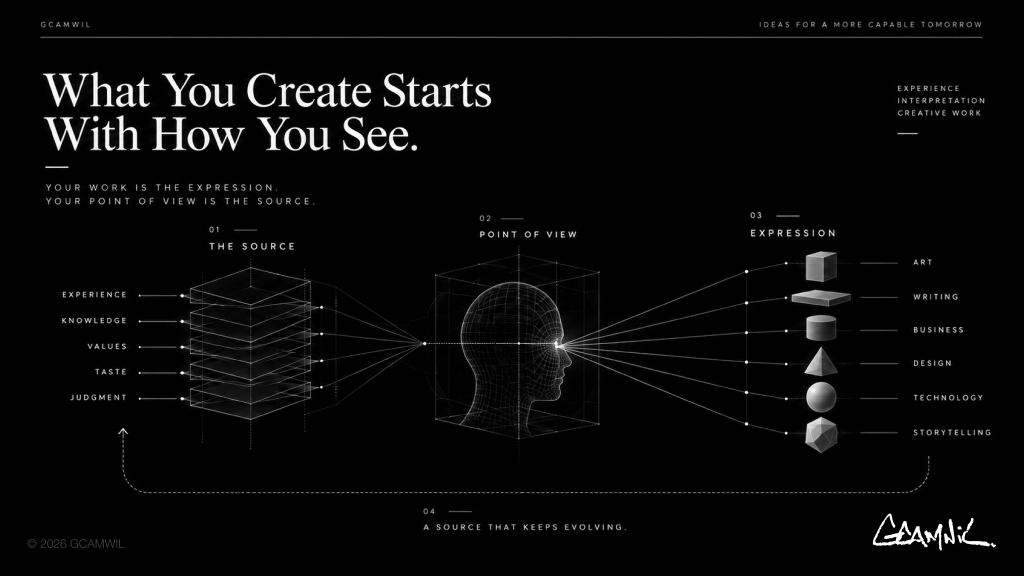
Look at how far downstream the finished artifact actually sits.
By the time someone encounters your essay, painting, product, film, company, photograph, or piece of software, you’ve already made an enormous number of decisions they may never see.
And this is where generative AI becomes particularly interesting to me.
If a generative system gives me twenty directions, it hasn’t relieved me of authorship.
It’s given me twenty decisions.
I still have to know what belongs, what’s missing, what needs to be pushed further, what should be removed, what can be combined, what’s merely impressive, what’s actually useful, and what looks like a good answer while fundamentally misunderstanding the problem I’m trying to solve.
The machine expands the field of possibility.
I still have to govern what survives.
That’s the relationship between point of view and capability.
Point of view without capability is unrealized interpretation.
You can see something remarkable and still lack the ability to make it legible to anyone else.
Capability without point of view is increasingly substitutable production.
You can become extremely capable at making things while having very little reason for choosing one thing over another beyond convention, instruction, or whatever the machine happened to propose.
Put the two together:
Capability × Point of View = Differentiated Execution
Now the craft has direction. The tools have intent. Production becomes leverage applied to judgment.
That’s why I don’t think the useful response to increasingly capable machines is to spend the next decade trying to become a faster machine.
The machine is going to win that contest.
Generative systems can already produce large numbers of candidate outputs at machine speed, and their capabilities across writing, coding, image generation, information retrieval, and other knowledge tasks continue to improve rapidly. I’m not saying AI universally outperforms humans across those domains. I’m saying that competing with software primarily on volume and generation speed is unlikely to remain a durable human advantage.
And it doesn’t get tired halfway through version thirty-seven and decide version four was probably fine.
Your job is different.
Collect reality. Learn enough to notice more of it. Develop your taste. Interrogate your assumptions. Move between disciplines. Pay attention to the patterns you keep seeing. Make things. Watch what survives. Change your mind when reality gives you a good enough reason.
Then make again.
Over time, that repeated contact between your mind and the world starts producing a recognizable way of interpreting it.
And this is where I think AI can become leverage instead of identity.
If I ask a machine for twenty possibilities and accept the first competent answer because it sounds good enough, I’ve done more than accelerate execution. I’ve delegated part of the selection process to the system.
But if I know what I’m looking for, recognize what’s missing, challenge what doesn’t fit, reject attractive answers that misunderstand the problem, and keep directing the process toward an intention I can actually articulate, the same technology functions very differently.
It expands what I can produce without becoming the reason I produced it.
So for me, the interesting distinction isn’t whether AI touched the work.
It’s where the judgment resides.
And the more capable the tools become, the more consequential that distinction becomes.
Access to the tool can’t be the advantage if everyone has the tool. Producing more can’t be the entire advantage if everyone can produce more. The advantage has to move toward whatever determines how that capability gets used: what you notice, what you understand, what you value, what you select, what you reject, and ultimately, what you decide deserves to exist.
But here’s the problem we still haven’t solved.
If you keep expressing those decisions, other people can study them. Publish enough work and yesterday’s judgment becomes visible. Your preferences become patterns. Your patterns become learnable.
Eventually, yesterday’s point of view can become part of the abundance too.
So the moat can’t depend on yesterday remaining impossible to copy.
The source itself has to keep moving.
The Moat Has to Move
There is one problem with calling point of view a moat.
The word makes it sound permanent.
In business, that is usually the point. A moat protects an advantage by making something harder to compete with, reproduce, or replace. But when you apply the metaphor to a person, it can lead you toward a claim I don’t think we can defend: develop a distinctive enough point of view and eventually you’ll own some intellectual territory nobody else can enter.
You won’t.
People can copy your ideas, imitate your style, adopt your language, study your methods, borrow your conclusions, enter your market, and sometimes take something you created and make a better version of it. The more work you publish, the more material you give them to study. Put years of your work in front of someone and patterns begin to emerge: your preferred structures, recurring themes, aesthetic choices, arguments, references, and the things you consistently reject.
Yesterday leaves evidence. And evidence can be studied.
AI makes that even harder to ignore. Research into LLM style imitation already shows that models can reproduce some surface-level characteristics of an author’s writing, and that providing examples of a person’s work can improve stylistic alignment. But the evidence also gives us a reason not to overstate the capability: current systems still struggle to reproduce the deeper and more implicit characteristics of an individual’s writing consistently.
So when I say your point of view can become a moat, I don’t mean your work eventually becomes impossible to reproduce. I mean something closer to non-substitutability.
Because copying something I made isn’t the same as replacing the source that made it.
You might reproduce one of my paintings without knowing what will catch my attention next. You might imitate one of my essays without knowing which experience will change my mind. You might recreate the surface of one of my companies without understanding how I’ll respond when the assumptions behind its operating philosophy stop working.
You can study decisions I’ve already made. The harder problem is making the next decision when reality changes.
And I think that’s where point of view becomes more interesting than style.
Style can become static. So can perspective. An artist finds an aesthetic people respond to and keeps repeating it. A writer discovers a format that performs and starts forcing every idea through it. A company succeeds with one model and begins interpreting every new opportunity through the assumptions that created the old one. Eventually, what made you recognizable starts making you predictable. The signature becomes a formula.
The moat stops moving.
A living point of view works differently because it stays in contact with reality. You learn something you didn’t know. You acquire a new skill. You build something and discover the theory doesn’t survive implementation. You meet someone whose experience contradicts your assumptions. You enter another discipline and finally find language for something you’ve sensed for years. Something you were convinced would work fails. The culture changes. You change your mind.
Then you return to the world carrying a slightly different instrument for interpreting it.
Every new encounter with reality gives us something to work with. We gain experience, acquire knowledge, and notice things we previously overlooked. Those discoveries can challenge our existing assumptions, refine our judgment, and change how we interpret the world.
And when our interpretation changes, so can the things we create.
The source evolves because you do.
Which brings me back to the list I started with.
Artist. Entrepreneur. Marketer. Writer. CEO. Educator. Worldbuilder.
For years, I thought those identities needed to collapse into one category before all of my work would make sense together. I don’t think that anymore.
A painting doesn’t need to look like a business system. A business system doesn’t need to resemble an essay. An essay doesn’t need to resemble a fictional world. The coherence can exist further upstream, in the questions I keep asking, the principles I keep testing, the relationships I keep noticing, the ideas I keep revising, and the accumulated way I’ve learned to make sense of what I encounter.
The mediums can change because the source travels with me. But the source can’t merely travel. It has to remain alive.
That’s why having a unique perspective isn’t enough. You can be uniquely incoherent, misinformed, or irrelevant. A point of view becomes valuable when it has enough knowledge behind it to inform what you see, enough judgment to evaluate what you find, enough relevance to matter beyond yourself, enough coherence to survive repeated decisions, and enough capability to turn what you see into something another person can experience, use, question, or understand.
Execution still matters. I’ve never been arguing that production becomes worthless as point of view becomes more important. What I’m saying is that as productive capability becomes more accessible, production alone carries less of the burden of differentiation.
The advantage moves upstream: from the artifact to the decisions behind it, from those decisions to the judgment behind them, and from that judgment to the accumulated way of seeing that keeps producing new decisions as reality changes.
That’s what I mean when I say your point of view becomes a moat.
Not a wall around your work, but a living source that becomes increasingly difficult to substitute.
When production becomes abundant, the scarce advantage moves upstream. Your moat is not merely what you can make. It is the accumulated way you see, judge, interpret, and decide what is worth making.
They can copy what you made yesterday.
They still have to figure out what you’ll see tomorrow.
Garett
PS: Know someone who would benefit from this? Send them this link → subscribe.garettcampbellwilson.com
Want more insights on mastering the creator economy? Follow me on Instagram @gcamwil and stay updated on the latest strategies.
Start Here: The Digital Renaissance Manifesto
The system wasn’t built for creators. The traditional career path is collapsing, and the future belongs to those who create, not just those who comply. But how do you transition from being trapped in the old system to thriving in the new one?
That’s exactly what I break down in The Digital Renaissance Manifesto: your essential guide to understanding how creativity, technology, and ownership are merging to create the biggest wealth shift of our time.
Read The Digital Renaissance Manifesto – If you’re ready to stop trading time for money and start building leverage, this is where you begin.
Keep Learning: Related Reads
- YOU DON’T NEED A PERSONAL BRAND. UNTIL YOU NEED ONE.: How to package your knowledge, point of view, or process into digital assets that don’t expire when your shift ends.
- HOW TO TAP INTO THE WEALTH TRANSFER NO ONE TALKS ABOUT: There’s a silent wealth transfer happening. It’s happening in human attention.
- THE 9 TO 5 IS DEAD. NOW WHAT?: Why some are waking up to the fact that relying on a single employer for financial security is too risky.