



Sometimes the most valuable thing you create is something you never get to see the results of.
Back in 2015, I spent a few months teaching art to a group of kids in Richmond, British Columbia. Most of them were five, six, or seven years old. Some were still learning English.
We worked with different materials, practiced drawing, and spent a lot of time figuring things out together.
Of course, I wanted the kids to enjoy what they were making. But I wasn’t particularly concerned with whether every drawing turned out beautifully. I was more interested in what happened along the way.
I’ve always thought drawing was a useful way to learn how to solve problems.
You look at something and try to understand what you’re seeing. You make decisions about shapes, proportions, and how different things relate to one another. Then you put something on the page, realize it doesn’t look quite right, and have to figure out why.
Maybe you erase a line. Maybe you start again. Or maybe you discover that what you thought you were looking at wasn’t quite what was there.
That’s the part that stays with me.
The drawing is one result. But there’s also the experience of figuring out how to make it.
And that’s where I think the distinction between being creative and being a creator becomes useful.
To me, being creative is having the capacity to imagine, interpret, or approach something differently. Being a creator is what happens when you put that capacity to work. You make something, try to solve a problem, or bring an idea into the world and discover what happens when it meets reality.
That’s what I wanted my students to experience.
I wasn’t trying to turn every student into an artist. I wanted them to become more comfortable looking at something unfamiliar and figuring out what to do next.
Of course, that meant adjusting how I taught. Every child approached things differently. An explanation that made perfect sense to one student could leave another completely confused, so I had to keep finding new ways to communicate the same idea.
I was figuring things out, too.
At the end of the semester, I handed out certificates, the classes finished, and everyone went their separate ways.
I knew what we’d worked on and what I’d tried to teach them. What I couldn’t know was whether any of it would still be useful years later.
I’ve encountered that same uncertainty in my work as an artist and marketing agency owner. You can put tremendous thought into creating something for another person, but once they have it, you don’t necessarily get to see what happens next.
And sometimes that’s where the work begins to matter in ways you couldn’t have predicted.
Think about something a teacher taught you that you still use today.
Maybe it was a way of approaching a problem, organizing your thoughts, or understanding something that once seemed difficult. You might remember the teacher. You might not have thought about them in years.
But you’re still using something they gave you.
And there’s a good chance they have no idea.
Someone can spend an afternoon showing you how to do something, and years later, that experience might still be influencing the decisions you make. They could have moved on to an entirely different life. You might never see them again.
But something they shared is still at work.
Which makes me wonder about all the things we create for other people.
What happens to that value when we’re no longer there to sustain it?
Some of Your Best Work Won’t Have Your Name on It
It’s interesting what we choose to remember about the people who came before us.
We remember the buildings they designed, the books they wrote, the companies they started, and the paintings they made. Sometimes we even put their names on those things so nobody forgets who was responsible.
And I understand why.
There’s something remarkable about creating something that continues to exist long after you’ve finished working on it. Especially when you consider how much time, effort, and uncertainty can go into making something worthwhile.
Those achievements deserve recognition.
But I’ve also wondered how much of what people contribute to the world never becomes something we can point to.
Consider how many decisions you make in a day using knowledge you didn’t develop entirely on your own.
Maybe you learned how to organize your work from a former colleague. Someone showed you a better way to approach a difficult conversation. Or you developed a particular way of solving problems after watching how someone else handled them.
Over time, those things become part of how you operate. You make adjustments, combine what you’ve learned with your own experience, and gradually stop thinking about where those habits came from.
Something that began as another person’s way of doing things becomes yours.
And eventually, you might pass it along to someone else without realizing you’re continuing something that started long before you encountered it.
That’s a different kind of contribution because it becomes harder to recognize the further it travels.
A building has an architect. A book has an author. A painting has an artist.
But what about the way someone taught you to think?
That influence can become so thoroughly mixed with your own experiences that separating one person’s contribution from another is almost impossible.
And yet it can still affect what you do.
I make art myself, so I understand why people want to preserve objects that represent someone’s creative achievement. I don’t think those things become any less valuable because other contributions are harder to see.
I just don’t think the finished object tells us everything about what a person contributed.
Some of what we create remains recognizable as our work. Some of it becomes part of someone else’s.
But there’s another question worth considering.
Just because something continues to be used, does that mean it’s actually doing what it was supposed to do?
You Fixed Something. But Did You Solve Anything?
I’ve noticed that we’re pretty good at finding ways to make problems easier to deal with.
We’re not always as good at making them go away.
Take a business that keeps receiving the same customer complaints.
Someone decides the company needs a better way to respond. They organize the incoming messages, write clearer answers, and develop a system that helps the team respond more quickly.
And it works.
Customers get answers faster. Employees spend less time dealing with the same questions. Everyone feels like things are improving.
Except the complaints keep coming.
Maybe the product is confusing. Maybe the company keeps promising something it can’t consistently deliver. Or maybe there’s something about the customer experience nobody has taken the time to understand.
Whatever the reason, the company has become better at responding to a problem it hasn’t actually solved.
I’ve seen how easily that happens elsewhere.
A process takes too long, so we create another process to manage it. Information isn’t reaching the right people, so we add another meeting. Something isn’t working, and rather than change it, we find a way around it.
Sometimes that’s exactly what we need.
If something breaks in the middle of an important project, you might not have the time to investigate every underlying cause. You need to get things working again. The deeper investigation can come later.
But what happens when later never comes?
A workaround that was supposed to get everyone through a difficult week becomes the way a company operates for years. People learn to accommodate the problem rather than question why it keeps happening.
Eventually, the workaround feels normal. The original problem becomes part of how things are done.
And that’s where creating something useful becomes a little more complicated.
You can make something people appreciate, depend on, and continue using without ever addressing the thing that made it necessary.
That doesn’t make the work worthless. But it does mean we should be more precise about what we’ve accomplished.
Did we solve the problem we set out to solve? Make it easier to live with? Or create something that helped for a while but now needs to be reconsidered?
Those are different outcomes, even when the people using what we’ve created are satisfied with the result.
And sometimes, before we can make that distinction, we have to confront another possibility.
The problem we’re trying to solve might not be the problem we think it is.
What If You’ve Got the Problem Wrong?
One thing I’ve learned about solving problems is that people aren’t always describing the problem itself.
Sometimes they’re describing what it’s like to live with it.
A customer tells you something is too expensive. An employee says they don’t have enough time. Someone tries using something you’ve created and tells you it’s too complicated.
You listen, take their concerns seriously, and try to understand what’s happening.
But are they describing what’s wrong, or what they’re experiencing because something is wrong?
Sometimes it’s both. Sometimes they’re absolutely right about what needs to change. The challenge is recognizing the difference without assuming you understand their situation better than they do.
I’ve encountered a version of this through drawing.
You can study an object for quite a while and feel confident that you understand what you’re seeing. Then you try putting it on paper.
Suddenly, the proportions are wrong. Something doesn’t line up. The shape you thought you understood is more complicated than it looked.
So you look again.
And this time, you notice something you missed.
That’s one of the things I’ve always appreciated about drawing. It reveals the difference between what you think you’re seeing and what’s actually in front of you.
Something similar happens when you’re creating for another person.
Someone comes to you with a problem, and almost immediately, you start imagining solutions. You recognize something familiar, remember a method that’s worked before, or realize you already know how to make something that could help.
Before long, you’re thinking about what to build.
But you haven’t necessarily finished understanding what you’re building it for.
Take a business owner who wants a new website because sales have slowed.
You could improve the navigation, rewrite the copy, develop stronger visuals, and make the entire experience more professional. The finished website might be excellent.
And maybe that’s exactly what the business needs.
But what if the website isn’t the reason sales have slowed?
Perhaps customers don’t understand why the product is worth buying. Perhaps the offer itself isn’t compelling, or the business is trying to reach people who were never particularly interested in what it’s selling.
A new website might improve the presentation without changing the situation that prompted the project.
That’s an uncomfortable possibility, especially when you’re good at making things.
Once you’ve imagined a solution, it’s easy to become invested in it. You can see what it could look like, how you’d build it, and how satisfying it would be to bring the idea to life.
And sometimes the most useful thing you can do is question whether it needs to exist at all.
I don’t think that’s a failure of creativity. I think it’s part of developing better judgment.
You become less interested in proving your original idea was right and more interested in understanding what the situation requires.
Sometimes that means making something different. Sometimes it means making something simpler. And other times it means recognizing that the person you’re trying to help doesn’t need another thing created for them.
They need something to change.
Even when you’ve understood the situation correctly, though, that understanding has a shelf life.
People change. Circumstances change. What works today might need to become something else tomorrow.
Someone Else Might Do It Better Than You
Something changes when other people start using what you’ve created.
They find shortcuts. Ask questions you never thought to answer. Use something for a purpose you hadn’t considered, or ignore a feature you spent weeks developing because it doesn’t matter nearly as much to them as it did to you.
And sometimes they make it better.
You can spend months developing something, refining the details, and trying to anticipate how it’ll be used. Then someone comes along with a different perspective and notices something you missed.
It’s tempting to defend the original idea. After all, you know why you made those decisions.
But the person using your work knows something you don’t. They know what it’s like to live with it.
Consider a business owner who develops a better way for their team to handle an important part of the operation.
At first, the owner is involved in almost everything. They explain the process, answer questions, and make adjustments when something goes wrong.
Eventually, the team knows what to do without asking.
The owner can step away.
That’s a significant achievement. Something that once depended on one person’s knowledge can now function through the capabilities of several people.
But a few years pass, and the business isn’t quite the same.
There are new employees. Customers expect different things. The tools have changed. A process that once made everyone’s work easier now requires extra steps just to keep it functioning.
It might have been exactly what the business needed when it was created.
That doesn’t mean it’s still the best way to do things.
Sometimes the best thing that can happen to your work is for someone else to change it.
They might improve the process, simplify the method, or combine your idea with something you never considered. Eventually, they might replace it altogether.
That doesn’t erase the value of what you created. In some cases, your contribution gave someone else a place to begin.

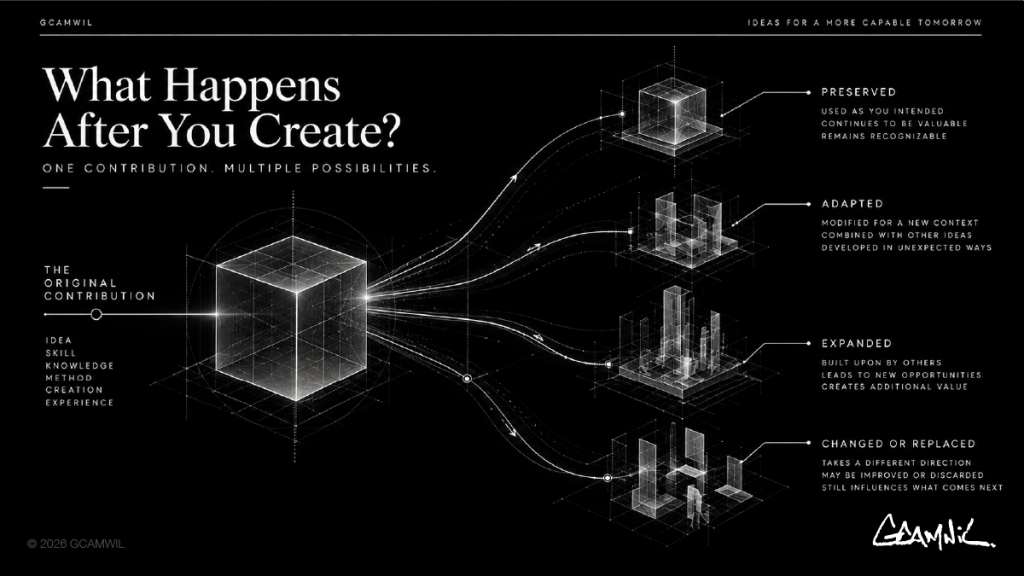
Of course, not every change is an improvement.
People can misunderstand an idea, remove something important, or use a solution in ways that create new difficulties. And when other people depend on what you’ve made, it’s worth considering what responsibility you still have.
Some decisions need explaining. Others need documenting. Sometimes you need to remain involved long enough for people to understand how to use what you’ve created responsibly.
But you won’t always be there to answer questions, and you can’t expect the world to remain exactly as it was when you made something.
So I think it’s worth asking whether you’ve created something other people can actually work with.
Something they can understand, question, maintain, or improve.
Because if the value of your work depends entirely on you being there to explain it, defend it, or keep it functioning, there’s a limit to how far that value can travel.
Maybe the greatest thing about creating something useful isn’t that it remains exactly as you left it.
It’s that someone else can take it somewhere you never could.
You Don’t Get to Decide What Happens Next
Every once in a while, I wonder what happened to those kids I taught back in 2015.
They’d be teenagers or young adults now. Some might still enjoy drawing. Others might have found interests that have nothing to do with art.
I stayed in touch with a handful of students over the years, but I couldn’t tell you exactly what any of them took away from our time together.
Maybe someone still uses something we practiced. Maybe the experience helped them approach an unfamiliar problem years later. Or maybe those classes were simply a few enjoyable afternoons in their childhood.
I don’t know.
And I don’t think I’d want to measure the experience entirely by what I could find out today.
There are people who’ve influenced how I think and work who probably have no idea what I’ve done with something they taught me. Some might not even remember the conversation.
I’ve also taken things I’ve learned from other people and changed them so much over the years that the original idea might be difficult to recognize.
I imagine that’s true for most of us.
We don’t always get to see where our contributions end up. And when we do, they don’t always look the way we expected.
I think about that when I’m making art, developing something for a business, or trying to explain an idea to someone.
You can do your best to understand what another person needs. Put care into what you make. Give them something they can work with.
But you can’t live the rest of their life for them.
Eventually, they decide what to do with it.
That doesn’t mean the choices you make while creating something don’t matter. You can still consider whether you’re addressing the right problem, whether what you’ve made is genuinely useful, and whether another person can understand or improve it without you.
You just won’t always be there to find out.
Think about the people who’ve helped you become capable of things you once couldn’t do.
You might remember exactly what they taught you. Or their contribution might have become such an ordinary part of how you think and work that you rarely consider where it came from.
Now consider what you’ve made possible for someone else.
It might be something you built, something you taught, a problem you helped solve, or simply a better way of doing something that another person can now use.
You might never know how far that contribution goes.
But the next time you have an opportunity to create something useful, I think there’s a question worth asking.
When I’m no longer there, what will this allow someone else to do?
Garett
PS: Know someone who would benefit from this? Send them this link → subscribe.garettcampbellwilson.com
Want more insights on mastering the creator economy? Follow me on Instagram @gcamwil and stay updated on the latest strategies.
Start Here: The Digital Renaissance Manifesto
The system wasn’t built for creators. The traditional career path is collapsing, and the future belongs to those who create, not just those who comply. But how do you transition from being trapped in the old system to thriving in the new one?
That’s exactly what I break down in The Digital Renaissance Manifesto: your essential guide to understanding how creativity, technology, and ownership are merging to create the biggest wealth shift of our time.
Read The Digital Renaissance Manifesto – If you’re ready to stop trading time for money and start building leverage, this is where you begin.
Keep Learning: Related Reads
- YOU DON’T NEED A PERSONAL BRAND. UNTIL YOU NEED ONE.: How to package your knowledge, point of view, or process into digital assets that don’t expire when your shift ends.
- HOW TO TAP INTO THE WEALTH TRANSFER NO ONE TALKS ABOUT: There’s a silent wealth transfer happening. It’s happening in human attention.
- THE 9 TO 5 IS DEAD. NOW WHAT?: Why some are waking up to the fact that relying on a single employer for financial security is too risky.