


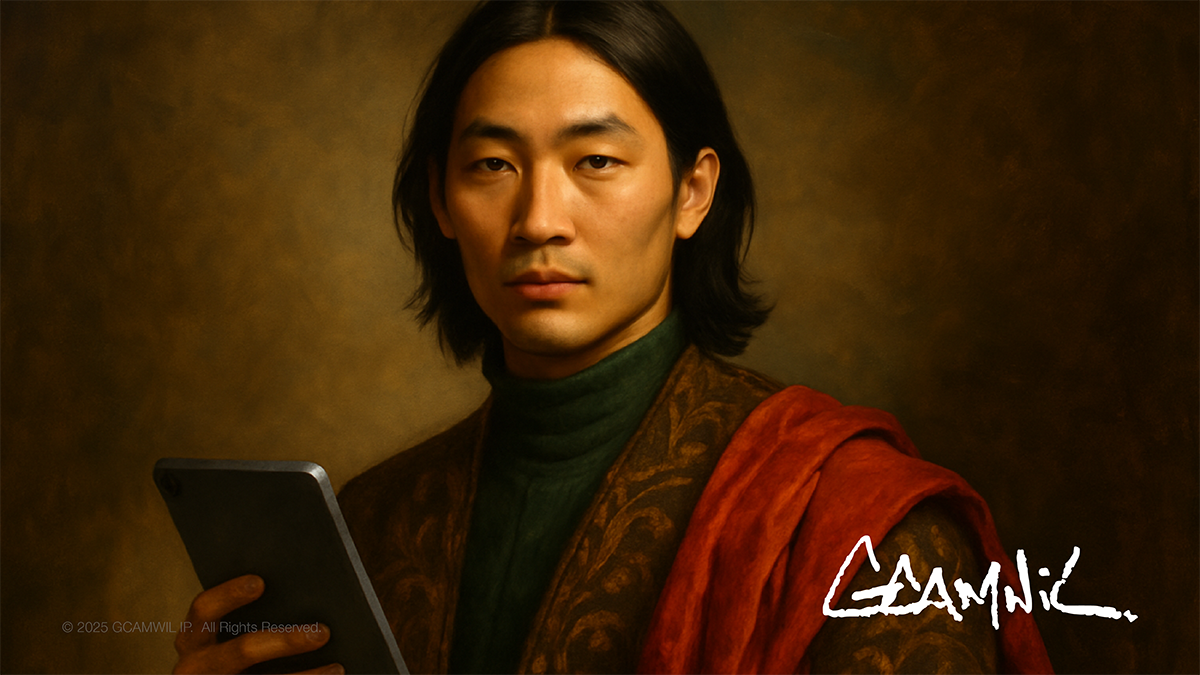
When I first started painting people, I thought I was capturing likeness. A curve of a jaw, the glint of light across a cheek, the weight of someone’s presence rendered in oil and stillness. But over time, I realized I wasn’t painting what I saw. I was painting what they were becoming. Each portrait was less a reflection and more a prophecy. I began to understand that art isn’t about representation—it’s about recognition. What we create isn’t a mirror of the present; it’s a record of the soul mid-evolution. And if you look closely enough, every brushstroke tells you what the subject was afraid to admit: that identity isn’t fixed. It’s a living architecture being built in real time.
People often ask me why I paint sovereignty. They think it’s about control or independence, but it isn’t. Sovereignty is not rebellion—it’s return. It’s the moment someone reclaims authorship over how they are seen, felt, and remembered. When I paint, I’m not documenting features. I’m designing frequency. I’m trying to capture the exact voltage of a person who has remembered who they are. Because when someone steps into that state, even for a second, it changes everything. Their posture shifts. Their eyes stop scanning the room for permission. Their voice drops into the body. That’s the moment I’m after. The image is just evidence of it.
For years, I didn’t have the language for what my portraits were really doing. I thought I was just an artist building a portfolio. But as I studied creators, founders, and thinkers, I noticed a pattern. The ones who transcended trend cycles all had one thing in common—they built visual totems that anchored their identity in the collective imagination. These were not brand photos; they were symbols. Icons. Archetypes made flesh. I began to see that portraits could serve as identity architecture in the Digital Renaissance. In a world where attention erases context, you need artifacts that hold meaning. The Sovereign Portrait became that artifact.
The first time I painted myself through that lens, I saw it clearly. The face on the canvas wasn’t me as I was; it was me as I was becoming. The light, the stance, the silence—it all carried a code. It wasn’t vanity. It was vision. When you externalize identity, you start to interact with it differently. You stop trying to perform it and start to inhabit it. That’s the secret function of art in a digital age—it turns self-concept into structure. It gives your future a place to live before it arrives. The portrait is the prototype.
Over time, I developed what I now call the Sovereign Portrait Model. It’s not about aesthetics. It’s about energetics. The process always begins with a conversation, not a camera. I study the person like a system: their language patterns, nervous system cadence, creative rituals, unspoken motives. I listen until the archetype reveals itself. Some come in with Operator energy—focused, precise, almost mechanical. Others lead with Artist fire—raw, magnetic, emotionally fluent. My job is to translate that internal architecture into a visual form that can hold it. Every color choice, angle, and texture becomes a decision about identity. The finished piece is less a painting and more a mirror that doesn’t lie.
I remember painting a founder who had spent years hiding behind her company. On paper, she was successful. In presence, she was absent. During our first session, she spoke about numbers, markets, projections. Not once did she use the word “I.” I asked her what she wanted the portrait to say. She paused, then whispered, “That I was here.” When the final piece was unveiled, she cried—not because it was beautiful, but because it looked like her truest self. For the first time, she saw the woman who built the empire, not the empire that consumed the woman. That’s when I knew this work was no longer art. It was reclamation.
Painting sovereignty taught me that image is the most underused instrument of self-possession. In the digital economy, everyone talks about content, but few talk about containers. Content is fleeting. Containers hold power. A portrait is a container—it holds belief. When you build enough containers of belief, you start shaping culture. Every creator who understands this begins to operate like a myth-maker. They stop selling products and start transmitting symbols. The difference between a brand and a legacy is simple: a brand markets ideas; a legacy embodies them.
My own portraits became milestones of internal seasons. Each one marked a psychological evolution—a timestamp in my personal sovereignty. I could trace the transitions through light and tone. The early ones were dark, grounded in survival. Then came the metallic phase, when I was obsessed with precision and performance. The latest ones are quieter, open, less defended. They reflect integration. You can tell where someone is in their journey by how much they’re willing to be seen. Visibility reveals healing. The more you integrate, the less you need to posture. True power has nothing to prove.
At some point, the work became circular. I wasn’t just painting others; they were painting me back, energetically. Each subject reflected something I was still learning about myself. One portrait taught me humility, another discipline, another softness. The studio became a mirror hall of archetypes. The Artist in me met the Operator across the easel. The Philosopher whispered through the silence between strokes. The Architect arranged every element like a system diagram. The Investor hovered in the background, reminding me to build something that compounds. Every painting was a conversation among selves disguised as an image of someone else.
I realized that art, at its highest level, is systems design. It organizes chaos into coherence. The Sovereign Portrait is not just an aesthetic exercise—it’s a leadership tool. When a person sees themselves encoded as myth, they start leading differently. They speak from embodiment, not aspiration. That’s why I tell clients: the portrait is not for your wall; it’s for your nervous system. It’s a calibration device. Every time you look at it, you remember who you are before the world told you otherwise. That’s how identity stays intact in the noise.
There’s a discipline to this kind of creation. It’s not glamorous. It’s psychological labor disguised as art. You have to hold people through the discomfort of being witnessed without filters. Many cry. Some go silent. A few laugh uncontrollably. The nervous system doesn’t always know what to do when met with truth. My job is to translate that moment into form. To hold still long enough for recognition to surface. When it does, something alchemical happens—the subject shifts from model to myth. You can feel the click. A field locks into place. The portrait becomes alive.
In those moments, I understand why the old masters painted gods. They weren’t documenting divinity; they were installing it. They were reminding us that we could be both mortal and magnificent. The Digital Renaissance is no different. We’ve replaced marble with pixels, pigments with photons. But the mission is the same: to encode human sovereignty into the fabric of culture. That’s why I paint. Not to decorate walls, but to design belief systems.
If you look at the portraits closely, you’ll see the recurring motif of light. Sometimes it’s a soft glow from the side. Sometimes it cuts like a blade across the face. That’s deliberate. Light, for me, represents consciousness—what the subject has accepted and what they’re still hiding from. The balance between shadow and exposure is the story of every creator. Too much shadow and the message is lost. Too much exposure and the essence burns out. The portrait is where both learn to coexist.
One day, I painted in silence for ten hours straight. No music, no phone, no movement outside the brush. When I stepped back, I saw not a person but a principle. The realization was almost spiritual. Sovereignty isn’t loud. It’s not rebellion, performance, or posture. It’s the quiet confidence of alignment. That’s what I try to capture in every frame—the equilibrium between presence and purpose. When someone stands before their portrait and feels peace instead of pride, I know I’ve done my job.
In the business world, we talk about personal branding as differentiation. But differentiation without depth is decoration. The Sovereign Portrait bypasses that. It gives the brand a soul, a mythic identity rooted in truth. When people see that image, they don’t just remember your name—they remember how they felt when they looked at it. That feeling becomes your brand equity. That’s why art will always outperform algorithm. Algorithms chase attention. Art captures awareness. Awareness compounds.
Eventually, I stopped taking on commissions that didn’t have purpose. I’m not interested in painting people who just want to look powerful. I’m interested in painting people who want to be power—those willing to face the mirror and integrate what they see. Each session now begins with a question: “What are you trying to remember?” The answer tells me everything about how to paint them. Some are remembering softness. Some are remembering structure. Some are remembering silence. My brush becomes a record of their remembering.
I often think about what these portraits will mean decades from now. When someone’s grandchild stumbles upon the image of their ancestor not as a headshot, but as a myth—what message will it send? Maybe they’ll feel the same thing I felt the first time I saw an old self-portrait. The sense that legacy isn’t what you leave behind. It’s what you install in others through how you live. The portrait is proof of that installation.
Every artist reaches a moment where technique disappears and only truth remains. That’s where I live now. My work is less about paint and more about presence. Less about composition and more about consciousness. Each piece is a dialogue between human and archetype, time and timelessness. It’s my way of saying that in a world obsessed with speed, stillness is the ultimate luxury. Sovereignty is stillness that doesn’t break.
So if you’ve been building, scaling, or surviving, pause long enough to ask yourself: what would your Sovereign Portrait look like? Not the filtered version. The real one. The one that captures the calm after the storm. The one that says, “I was here, and I built something that built me back.” That’s not just art. That’s memory engineered into matter.
That’s why I paint sovereignty. Not to immortalize faces, but to document awakenings. Not to sell beauty, but to anchor truth. In every stroke, I’m building archives of alignment—proof that we were not just creators chasing relevance, but souls remembering who we’ve always been.
Garett
PS: Know someone who would benefit from this? Send them this link → subscribe.garettcampbellwilson.com
Want more insights on mastering the creator economy? Follow me on Instagram @gcamwil and stay updated on the latest strategies.
Start Here: The Digital Renaissance Manifesto
The system wasn’t built for creators. The traditional career path is collapsing, and the future belongs to those who create, not just those who comply. But how do you transition from being trapped in the old system to thriving in the new one?
That’s exactly what I break down in The Digital Renaissance Manifesto—your essential guide to understanding how creativity, technology, and ownership are merging to create the biggest wealth shift of our time.
Read The Digital Renaissance Manifesto – If you’re ready to stop trading time for money and start building leverage, this is where you begin.
Keep Learning: Related Reads
- YOU DON’T NEED A PERSONAL BRAND. UNTIL YOU NEED ONE.: How to package your knowledge, point of view, or process into digital assets that don’t expire when your shift ends.
- HOW TO TAP INTO THE WEALTH TRANSFER NO ONE TALKS ABOUT: There’s a silent wealth transfer happening. It’s happening in human attention.
- THE 9 TO 5 IS DEAD. NOW WHAT?: Why some are waking up to the fact that relying on a single employer for financial security is too risky.