

The first product I ever built was a mess. The landing page was overworked. The offer was too long. The copy was trying too hard. The backend held together mostly because I hadn’t asked it to do very much yet. I could see problems everywhere.
But the thing had one quality none of my plans possessed:
It existed.
I’ve always been comfortable in the architecture phase. Give me a complicated problem and I’ll happily disappear into it. I want to pull it apart, understand how the pieces relate, anticipate where it might break, and put it back together before it ever leaves the room.
That instinct has served me well. Much of my work has been built that way. My home office has essentially become a laboratory for turning ideas into businesses, essays, systems, courses, and intellectual property.
But architecture has a seduction hidden inside it. The better you get at thinking through problems, the easier it is to assume the next problem can also be solved by thinking harder.
That’s how I approached those early products and offers. I studied other founders. I reverse-engineered their systems. I added layers of logic to my own. And the reasoning felt perfectly responsible. If I could already see a weakness, why expose the work before fixing it? If something still felt unresolved, why not give it another hour?
So I kept trying to make the work clearer before allowing the work to teach me anything.
Then I started making versions.
That changed things.
An offer that seemed coherent in my head felt clumsy once it existed. Writing that sounded clever in conception became obviously excessive on the page. Systems I’d carefully reasoned through developed problems I couldn’t see until I had to use them. That took me a while to appreciate. These weren’t always problems I’d failed to think about.
Some became visible because there was finally something to observe.
Once the work existed, it could push back. It could be awkward. It could break. It could expose the distance between what I thought I’d built and what I’d actually built.
With each iteration, patterns became easier to see. My writing tightened. My sense of timing sharpened. Decisions that once required long periods of deliberation became more intuitive.
The work was no longer merely the output of what I knew.
It had become one of the ways I found out what I knew.
For a while, I thought this was simply the normal price of getting better. Make enough things and eventually your skill catches up with your ambition. I still think that’s true.
But something deeper was happening.
The planning wasn’t useless. Quite the opposite. It helped me understand the problem, eliminate obvious mistakes, and get close enough to make an intelligent attempt. But it could only take me so far.
Eventually, I was asking thought for information it couldn’t give me.
The rest was waiting on the other side of contact.
I think this is where a lot of smart, capable people can get stuck. The better you become at research, strategy, planning, and anticipating problems, the easier it is to assume that uncertainty means you haven’t thought enough yet. So you keep refining. You keep preparing. You keep looking for the piece of information that will finally make the decision feel clear.
Sometimes that information exists.
Sometimes it doesn’t exist yet.
That distinction matters because not every unanswered question is waiting to be solved the same way. Some answers can be found before you act. Others only become available once the idea meets a customer, the sentence meets the page, the system meets actual use, or your body attempts the movement you’ve been studying.
And that doesn’t mean the answer is to stop thinking and start throwing things at reality. I’m interested in something more precise than that: how do you know when preparation is still producing useful information, and when you’ve reached the point where some form of contact has to take over?
That question changed the way I think about execution.
Because if you can recognize that boundary, you can stop asking thought to do a job it can’t do without abandoning the judgment that made the preparation valuable in the first place. You can learn when to keep thinking, when to test, how much reality you actually need, and why experience only becomes useful when you know what to do with what happened.
What I want to show you is that execution isn’t simply what comes after clarity.
Sometimes it’s how clarity arrives.
Thinking Works. Until It Doesn’t.
Most of us are taught some version of the same rule early in life:
Think before you act.
It’s good advice. If you’re about to make an important decision, learn what you can first. If you’re entering unfamiliar territory, study it. If the consequences of being wrong matter, understand the risks. Planning can expose obvious problems before they become expensive. Preparation can keep ignorance from masquerading as courage.
The sequence feels almost self-evident:
Research. Understand. Plan. Decide. Execute.
Knowledge comes first. Action comes afterward. That’s how we tend to imagine responsible decision-making. Gather enough information to form an accurate picture of reality. Use that picture to decide what should happen. Then make it happen.
The better the thinking, presumably, the better the execution.
I’ve built much of my own life around this logic. Before I make something, I want to understand its architecture. Before I build a system, I want to know how the pieces relate. Before I commit resources, I want to understand what I’m committing them to.
That instinct has saved me from plenty of avoidable mistakes. Preparation isn’t some character defect I needed to overcome. I like being prepared. I like knowing what I’m walking into. Becoming better at preparation has made me better at making decisions.
The problem is that a useful principle can quietly expand beyond the territory where it remains true.
You get good at thinking ahead, so you think further ahead. You get good at anticipating problems, so you try to anticipate more of them.
Because that competence gets rewarded, the method starts to feel universal. Research works. Strategy works. Planning works. You solve enough problems before they happen that uncertainty itself starts to feel like evidence that you haven’t finished thinking.
If I’m still uncertain, there must be something I haven’t figured out yet.
So you keep working the problem. The writer keeps outlining because the essay still doesn’t feel resolved. The creator keeps refining the concept because the finished object isn’t completely visible. The entrepreneur keeps adjusting the offer before putting it in front of a customer. The learner keeps studying the movement because they don’t yet feel capable of performing it.
Sometimes that’s exactly what they should be doing.
There may be another book to read. Another precedent to study. Another risk to identify. Another skill to develop. There may be an obvious flaw that five minutes of careful thought could prevent from becoming five months of unnecessary repair.
Thinking is cheap compared with cleaning up a mistake you could’ve seen coming.
But eventually something strange can happen.
You’re still thinking. You’re still uncertain.
Yet the thinking is no longer producing new information.
That’s uncomfortable because the method that normally gives you clarity has stopped giving you clarity. So the natural response is more of the method.
Think harder. Research a little more. Refine the model again. Wait until the picture becomes clear enough to proceed.
Except that response contains an assumption we rarely examine:
That the information required to become clear already exists somewhere for us to find.
Sometimes it does. The answer may be sitting in a book, buried in data, contained in precedent, understood by someone more experienced, or waiting on the other side of another hour of concentrated thought.
But what if it isn’t?
What if the information you’re waiting for hasn’t been created yet?
Some Answers Don’t Exist Yet
Not every unknown is the same kind of unknown.
Some uncertainty exists because you’re missing information that’s already available. You don’t know the rules. You haven’t studied the precedent. You lack a prerequisite skill. Someone has solved the problem before, but you haven’t found their answer yet.
That kind of uncertainty rewards investigation. Read the book. Study the data. Ask someone who knows. Learn the technique. Understand the risks.
There’s little wisdom in learning the hard way what five minutes of research could’ve told you for free.
But another category of uncertainty behaves differently.
You can know everything available about how an audience should respond to an idea without knowing how your audience will respond to this one. You can understand the principles of good writing without knowing whether the paragraph you’re about to write will work. You can study sales without knowing whether a particular customer will buy. You can understand a movement mechanically without knowing what your own body will do when you attempt it.
These answers aren’t merely hidden.
They’re conditional on an interaction that hasn’t happened yet.
That’s a different kind of problem.
Some questions are missing answers because you haven’t found the information.
Others are missing answers because nothing has happened yet for you to know.
A chair can be beautifully resolved on paper. The dimensions can be calculated. The materials can be researched. The forces can be modeled. You can stare at the plans until you know every measurement by heart.
At some point, something still has to sit on it.
A prototype does something the drawing cannot.
It resists.
That resistance is useful.
The interface you designed in your head never confuses anyone. The business model inside the spreadsheet never meets the customer who behaves differently than expected. The essay in your imagination has no awkward sentences.
Then you make the thing.
Now reality has something to respond to.
This is what makes prototyping so useful in design. A prototype isn’t merely a worse version of the finished object. It can be a way of asking reality a question. You make something concrete enough to interact with, observe what happens, and discover what was difficult to see while the idea remained abstract. Making and testing become ways of learning under uncertainty, not simply what happens after the thinking is finished.
David Kolb’s work on experiential learning describes a broader version of the same cycle: concrete experience, reflective observation, abstract conceptualization, and active experimentation. Something happens. You observe it. You make sense of it. You form a better model. Then you return to the world and test that model again.
Notice what that does not mean.
Experience isn’t automatically knowledge.
The useful alternative to endless thinking isn’t mindless doing.
It’s contact.
Contact gives an idea something it can’t have while it remains inside your head: resistance. The material pushes back. The reader gets confused. The customer hesitates. The code breaks. Your body refuses to perform the movement the way you pictured it. The sentence that sounded brilliant in your imagination lands on the page and just sits there looking ridiculous.
Good.
Now you know something.
Not everything. Maybe not even what to do next. But you have information you didn’t possess before the encounter.
This is where the familiar relationship between clarity and execution starts to reverse. We normally think execution follows knowledge. First you understand what should happen. Then you make it happen.
But sometimes execution performs another function.
It creates the conditions under which the next thing can become knowable.
That doesn’t mean the answer was secretly sitting inside action all along. Execution creates the encounter. Reality supplies evidence. What you do with that evidence is another question.
For now, the distinction is simpler:
Some questions have answers waiting to be discovered. Other answers have to happen.
Once you understand that, it becomes easy to run too far in the opposite direction.
If reality can teach you what thinking can’t, why spend so much time thinking at all?
Doing Something Isn’t the Same as Learning
The easiest lesson to take from all of this is also the wrong one.
If reality can answer questions that thinking can’t, then stop planning. Move faster. Ship before you’re ready. Fail forward. Take action and figure everything else out along the way.
You’ve probably heard some version of this advice before. The internet loves turning hesitation into a character flaw. Thinking becomes procrastination. Preparation becomes fear. Speed becomes courage. Failure gets treated almost like a receipt proving you were brave enough to try.
There’s some truth buried in there. Plenty of people do hide inside preparation because it feels safer than exposure. But none of that makes action inherently intelligent.
Execution can produce evidence. It does not automatically produce understanding.
You can make the same mistake fifty times. You can launch something nobody wants and conclude the market is stupid. You can publish work that fails to connect and decide the audience simply doesn’t understand you. You can receive useful criticism and reject it, or receive terrible criticism and obey it.
Doing something over and over gives you experience. Whether you learn anything is another matter.
Failure is an event.
It is not an education.
Something still has to happen between experience and understanding. You have to observe what occurred, separate signal from noise, ask why the outcome differed from the expectation, and decide whether the assumption was wrong, the execution was poor, the sample was misleading, or the result revealed something you hadn’t considered.
That’s the part the slogans skip.
Reality produces evidence. Judgment converts evidence into clarity.
Feedback deserves the same caution. We sometimes talk about feedback as though reality hands us an instruction card after every attempt: Here’s what went wrong. Here’s why. Here’s what to do next.
It would be convenient.
Reality rarely speaks that clearly.
A customer can tell you they want something and never buy it. An audience can reward work that leads you away from the work you actually want to make. One successful experiment can be luck. One failed experiment can contain the right idea executed badly. The loudest response may not come from the people whose response matters most.
Contact gives you information.
It does not relieve you of the responsibility to think.
And none of this makes planning obsolete. Research reviewed for this essay found positive relationships between planning and performance across team and organizational contexts. There’s no reason to invent a fight between thinking and doing that doesn’t need to exist.
Planning works.
The mistake is asking planning to resolve uncertainties that only interaction can resolve.
There’s another reason the distinction matters:
Sometimes reality is an expensive place to learn.
A surgeon can’t respond to uncertainty by casually trying something on a patient to see what happens. A pilot shouldn’t encounter every possible emergency for the first time while carrying two hundred people through the sky.
“Just start” sounds considerably less profound when the downside is catastrophic.
And yet surgeons and pilots still need experience.
So high-consequence fields do something interesting:
They engineer the contact.
Medical education uses simulation to let practitioners perform, make decisions, receive feedback, and develop clinical skills without making a patient absorb the full cost of the learning process. Research reviewed for this essay found substantial benefits from simulation-based medical education paired with deliberate practice.
Aviation follows the same logic. Flight simulators allow pilots to encounter conditions that would be dangerous or impractical to experience for the first time in live flight.
Neither field eliminates preparation because experience matters. Neither eliminates experience because preparation matters.
They change the form of contact according to the consequences of being wrong.
That’s the more useful principle.
When mistakes are cheap and reversible, direct experimentation may be exactly what you need. As the consequences rise, the encounter may need to become smaller, more controlled, simulated, or preceded by more preparation.
This is why “just start” isn’t much of a philosophy. It treats action as though action itself were the virtue.
But the objective is not to maximize motion. It is not to fail as often as possible. It is not to collect scars so you can tell everyone how much you learned in the arena.
The objective is to get the information you need without being careless about what it costs.
So the question was never simply whether you should think or act.
The better question is:
What kind of contact does this uncertainty justify?
Know When You’ve Thought Enough
Once you stop treating thought and action as opposing philosophies, the decision becomes more precise. You don’t need to ask whether you should think more or act faster.
Ask:
What exactly am I uncertain about?
That question forces you to identify what kind of answer you’re actually looking for.
If the answer already exists, go find it. If you don’t understand the rules, learn them. If someone has solved the problem before, study what they learned. If the task requires prerequisite knowledge, acquire it. If the risks are known, understand them before exposing yourself or anyone else to them.
There’s no intelligence in paying for information that preparation could’ve given you cheaply.
But if the remaining uncertainty concerns what happens when the thing encounters reality, that’s where things change. You can keep researching, planning, and refining, but eventually none of it may produce the answer you need.
Then you need contact.
Make the draft. Build the prototype. Practice the movement. Test the system. Put the offer in front of someone. Use the thing you built.
Give reality something it can answer.
That’s why I prefer the word contact to action. Action is too broad. You can be extremely busy without getting anywhere near the uncertainty that matters.
You can spend months building a product without putting it in front of a customer. You can write every day without discovering whether anyone understands what you’re trying to say. You can endlessly modify a system while avoiding the conditions under which it’s supposed to operate.
You’re doing plenty.
You just aren’t finding anything out.
Activity is not the same thing as exposure.
The useful action brings the uncertainty into contact with whatever can answer it. And that encounter doesn’t need to be large.
One useful idea in Saras Sarasvathy’s work on entrepreneurship under uncertainty is affordable loss. Instead of organizing every decision around predicting the eventual return, consider what you can afford to put at risk while moving into uncertainty.
I like the principle because it changes the posture of the experiment. You’re no longer asking:
How much should I commit to prove this works?
You’re asking:
How much contact with reality can I responsibly afford in order to learn what I presently cannot know?
Sometimes the answer is very little.
You don’t need to manufacture ten thousand units to discover whether the prototype works. You don’t need to rebuild the entire company to test a new process. You don’t need a hundred customers to discover that the first five can’t understand the offer. You don’t need to publish the book to discover that Chapter Three doesn’t work.
You need enough reality to answer the question.
No more than necessary.
The objective is not maximum action.
It is the smallest responsible encounter capable of answering the question.
That encounter should change with the consequences. When the downside is cheap and reversible, test directly. When it becomes more expensive, prototype. When direct experimentation carries serious consequences, simulate. When the consequences could be catastrophic or irreversible, prepare until the remaining uncertainty falls within an acceptable boundary.
Somewhere inside that progression is a point worth naming.
I call it the Contact Threshold.
The Contact Threshold is the point at which the information still missing from a decision can no longer be efficiently acquired through preparation alone, and some appropriate form of interaction becomes necessary.
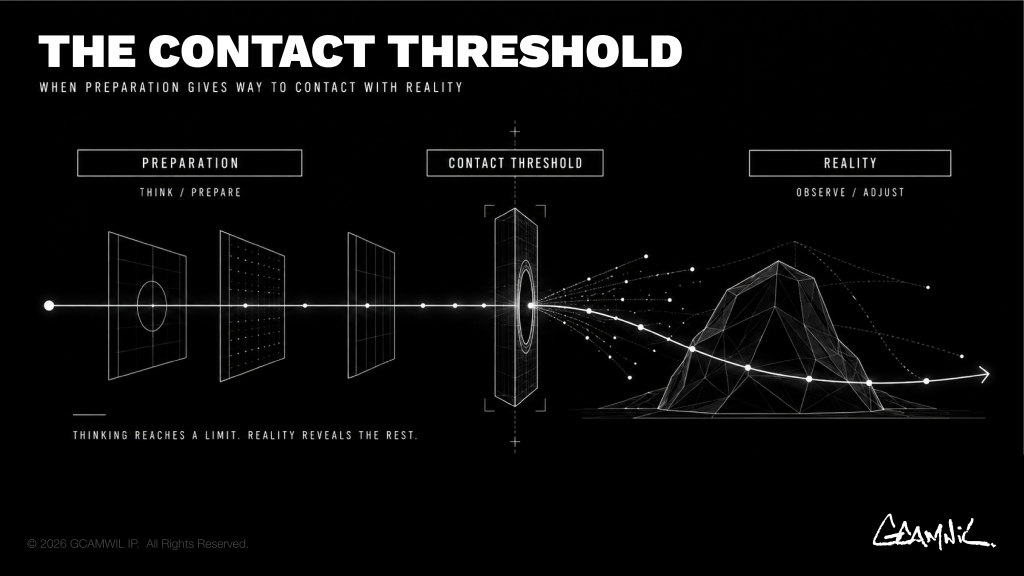
Before the threshold, another hour of thinking may genuinely help.
After the threshold, another hour of thinking may simply give you another hour of thinking.
Once you cross it, a different loop begins:
Prepare. Contact. Observe. Interpret. Adjust. Contact again.
Preparation gets you close enough to enter intelligently. Contact exposes the assumption. Observation tells you what happened. Interpretation asks what the evidence means. Adjustment changes the model. Then you return to reality with a better question.
None of those stages can replace the others. Preparation without contact eventually becomes speculation. Contact without observation becomes activity. Observation without interpretation becomes information. Interpretation without another encounter becomes a new theory waiting to be tested.
Underneath the entire loop sits something no framework can automate for you:
Judgment.
You still have to decide which feedback matters. You have to ask whether the experiment tested what you thought it tested. You have to decide whether the failure came from the idea or the execution, whether the risk is acceptable, and whether another round of preparation would improve the decision.
A framework can organize those questions.
It cannot answer them for you.
That’s where execution becomes more than movement.
It becomes judgment in motion.
Looking back, that’s what I was missing when I kept trying to architect my way into certainty. I didn’t necessarily need less preparation. Much of that preparation made the eventual encounter useful.
I needed to recognize when preparation had completed its job. At that point, another hour inside the architecture couldn’t tell me what one responsible encounter with reality could.
Which leaves a strange question.
If thinking helps us prepare for reality, but contact with reality changes what we think, where does the thinking process actually end?
Let Reality Into the Thinking Process
We like clean sequences because they make the world easier to understand.
Think. Know. Execute.
There are plenty of situations where that sequence works. The answer exists. The rules are understood. The path has been traveled before. Preparation gives you a sufficiently accurate map, and execution becomes the work of following it.
But uncertainty rarely stays that clean.
The moment your work depends on another person, an unfamiliar environment, an untested idea, a material you haven’t worked with, a capability you haven’t yet developed, or a future that hasn’t happened, the boundary between thinking and doing becomes harder to locate.
You form a model of what you think will happen. Then you enter reality.
Reality answers.
You observe what happened, decide what it means, and change the model. When you act again, you’re no longer acting from the same understanding that produced the first attempt.
Something happened between the two.
Reality entered the thinking process.
That’s what we get backward when we imagine execution as simply the stage that comes after thought. Thought gives you a map. Execution puts the map against the territory. Reality exposes the distance between the two. Judgment decides whether the map needs to change.
Then you go again.
Execution isn’t the opposite of thinking. It’s one of the ways thinking gets corrected.
That relationship is easy to miss because we associate intelligence with prediction. The person who knows what will happen before it happens appears more competent than the person who has to find out.
And sometimes they are.
Expertise should improve prediction. Experience should make certain mistakes unnecessary. Good judgment should reveal consequences a beginner can’t see. The purpose of learning isn’t to remain perpetually surprised by reality.
You should get better at seeing around corners.
You just shouldn’t expect to see around every corner.
Reality is too large for that.
Mature intelligence is knowing which parts of a problem can be understood in advance, which remain genuinely uncertain, and when the only responsible way to improve your understanding is to let some version of the idea encounter the world.
That creates a different relationship with clarity. You stop treating uncertainty as automatic proof that you’re not ready.
Sometimes you aren’t ready.
You need another book. Another conversation. Another hour of thought. Another skill. Another safeguard. Sometimes hesitation isn’t fear. It’s good judgment telling you that you haven’t done the necessary work.
But sometimes uncertainty means something else.
Sometimes you’ve reached the edge of information generated so far. You’re not supposed to know the outcome of an interaction that hasn’t happened. You’re not supposed to possess experience you haven’t lived.
No amount of confidence changes that.
No amount of planning changes it either.
Eventually, the map has done what a map can do.
You have to see whether the road is actually there.
That doesn’t make the map less valuable. It explains what the map is for.
The same is true of preparation.
Think until thought has done the work thought can do. Prepare until the remaining uncertainty no longer belongs to preparation. Then act, not because action is inherently superior, but because reality now possesses the information you need.
Then pay attention.
Making contact doesn’t mean reality will hand you a neat explanation of what happened. Execution creates the encounter. It doesn’t guarantee the lesson.
The lesson emerges from the conversation between what you expected and what happened, between the model and the evidence, between your judgment before contact and your judgment afterward. Then you carry that lesson into the next encounter.
This is why clarity doesn’t always precede action.
Sometimes clarity is the residue of intelligent contact with reality.
And once you see that, something else becomes obvious.
Every serious body of work eventually contains knowledge its creator couldn’t have possessed at the beginning. A painter learns things from the hundredth painting that were unavailable before the first. A writer discovers what they actually think by trying to put the thought into language. An entrepreneur learns things about customers that no spreadsheet could manufacture. A builder develops instincts because enough plans have collided with enough territory.
You can study before the first attempt. You should.
But you can’t study your way into having made the hundredth.
There are things the hundredth attempt knows that the first attempt cannot.
This knowledge wasn’t withheld because the creator failed to prepare.
Some of it had to be lived into existence.
That’s what happens when agency makes contact with the world. You think. You prepare. You enter the territory.
Reality answers.
And when you return, you’re carrying something you couldn’t have researched beforehand.
Experience.
Garett
PS: Know someone who would benefit from this? Send them this link → subscribe.garettcampbellwilson.com
Want more insights on mastering the creator economy? Follow me on Instagram @gcamwil and stay updated on the latest strategies.
Start Here: The Digital Renaissance Manifesto
The system wasn’t built for creators. The traditional career path is collapsing, and the future belongs to those who create, not just those who comply. But how do you transition from being trapped in the old system to thriving in the new one?
That’s exactly what I break down in The Digital Renaissance Manifesto: your essential guide to understanding how creativity, technology, and ownership are merging to create the biggest wealth shift of our time.
Read The Digital Renaissance Manifesto – If you’re ready to stop trading time for money and start building leverage, this is where you begin.
Keep Learning: Related Reads
- YOU DON’T NEED A PERSONAL BRAND. UNTIL YOU NEED ONE.: How to package your knowledge, point of view, or process into digital assets that don’t expire when your shift ends.
- HOW TO TAP INTO THE WEALTH TRANSFER NO ONE TALKS ABOUT: There’s a silent wealth transfer happening. It’s happening in human attention.
- THE 9 TO 5 IS DEAD. NOW WHAT?: Why some are waking up to the fact that relying on a single employer for financial security is too risky.