
Some of the most valuable things you’ve ever created might still be working for someone else. Long after you finished the job. Long after you got paid. Maybe long after you stopped thinking about them.
Think about something you’ve made for someone else. A design for a client. A presentation that helped close a deal. Maybe it was an idea that changed how a business operates, or a problem you solved that made someone’s job easier.
You did the work. You got paid, received the credit, or moved on. Fair enough. That’s how a lot of work gets done.
But the value of what you created doesn’t necessarily stop when you do.
That presentation might still be helping someone win business. That design might still be attracting customers. Something you figured out years ago might now be part of how an entire team works. And you might have nothing more to do with it.
And no, that doesn’t automatically mean someone took advantage of you. Maybe you got exactly what you wanted from the arrangement. But there’s something I keep wondering about.
What happens to the value we create after we’ve finished creating it?
I’ve spent a good part of my career helping other people build their businesses.
Long before the pandemic, I was already working remotely through CEREBRUM, my marketing agency, managing campaigns for clients I’d never met in person. We didn’t need to share an office or live in the same city. The work happened through screens, software, and conversations. The results happened wherever my clients were.
So when the world started shutting down in 2020, much of my digital work could continue as before. But the pandemic still disrupted productions, meetings, and projects that required us to be there in person. What changed was what I started noticing around me.
More people were teaching online, publishing ideas, offering services, and reaching customers they might never meet. They were finding ways to put their knowledge and abilities to work beyond the places they lived.
None of this started with the pandemic. But 2020 brought a shift that had been happening for years into much clearer view. Watching that happen made me look at my own work differently.
What caught my attention wasn’t simply that people could create valuable work from almost anywhere. It was how differently they might benefit from what they created.
Making something is one thing.
What happens to it afterward is a much bigger conversation.
The World Was Already Changing
Being good at something used to get you only so far. You also needed access to the people, companies, and institutions that could help you put that ability to work.
Think about a musician who wanted people to hear their music. Recording an album was one challenge. Getting it into stores, onto radio stations, or in front of an audience was another. A writer could spend years developing a manuscript and still need a publisher willing to take a chance on it. Someone with a promising product idea had to figure out how to manufacture, distribute, and sell it.
You could have the talent. You could have a great idea. But without the right connections or resources, good luck getting it off the ground. For a long time, much of the infrastructure that made those things possible belonged to somebody else.
Then the internet started changing the rules.
Not overnight. And certainly not for everyone. But little by little, people started doing things that once required an entire organization.
Musicians could record and release their own albums. Writers could publish directly to readers. Teachers could reach students in countries they’d never visited. Small businesses could find customers far beyond their neighbourhoods.
None of that made the work easy. You still needed skills, resources, relationships, and people who cared about what you were offering. But something had changed. Knowing how to do something and actually getting it out into the world were no longer quite so far apart.
And that’s where the internet gets really interesting to me.
We know how much faster the internet made things. We can communicate instantly, move money, access information, and work with people thousands of kilometres away. But speed is only part of the story.
Think about what happens when something you make can keep reaching people without you having to be there. A musician records a song, and someone discovers it five years later. A teacher explains something once, and that lesson helps students who were never in the room. A business publishes a useful article, and people keep finding it long after the writer has moved on.
The original effort happened at one point in time. The value can keep travelling.
That doesn’t mean everything takes care of itself. Music still needs distribution. Lessons need somewhere to live. Products need maintenance, support, and customers. But how far your work can travel no longer depends quite so much on where you are.
And once you see that, it’s hard not to wonder what else people might do with what they already know.
A skill doesn’t have to be useful only to people nearby. An idea doesn’t always need a large institution behind it. With the right knowledge, initiative, and tools, you can try things that would’ve been much harder a generation ago.
Not necessarily succeed. Attempt.
That distinction matters. The internet never made opportunity equal. Some people still have better equipment, more time, stronger networks, greater financial security, or easier access to the systems that help work get noticed. Removing one barrier doesn’t mean the others disappear.
But it can change who gets to participate.
And that’s part of what became so visible during the pandemic. People weren’t inventing remote work, online education, digital commerce, or independent publishing in 2020. Those possibilities already existed. What changed was how many people suddenly had a reason to explore them.
Some found new ways to do their jobs. Others began looking at skills they’d developed over the years and wondering whether those skills might be useful beyond their immediate circles.
For many, the question wasn’t just whether a company or institution would give them an opportunity anymore. It was whether they could create one themselves.
And that opened the door to a different kind of participation.
Anyone Could Begin
Something changes when you realize you don’t necessarily need a company, publisher, or employer to put your skills to work. You start looking at what you already know differently.
Someone who’s been taking photographs for years wonders whether people might pay for their pictures. An employee who’s always explaining things to colleagues realizes they could teach those skills outside the office. Someone who’s spent years getting good at something begins sharing what they’ve learned with people they never expected to reach.
It’s not that any of them suddenly became more capable. They already knew how to do those things. They just had more ways to find out whether anyone else might value what they knew.
And that’s what I find interesting about the creator economy.
When people hear that term, they often think of influencers, YouTubers, or someone trying to build a following on social media. But it’s much bigger than that. It can include people teaching what they know, making things others enjoy, offering creative services, developing products around their knowledge, or building an audience around work they care about.
Sometimes it starts with someone answering a question.
They explain how they solved a problem. A few people find it useful. Someone asks a follow-up question. Then another. Before long, they realize that what seems obvious to them might be useful to quite a few people.
Maybe they turn it into a business. Maybe they don’t. It could become a hobby, a contribution to a community, or a way to build their professional reputation.
Either way, they’ve discovered that something they learned through experience might be useful to people they’ve never met. And that changes how you think about your abilities.
For a long time, we’ve been used to describing ourselves through our jobs. Where do you work? What’s your title? What do you do for a living?
Fair questions. But a job title doesn’t tell you everything someone knows, what they’ve been through, or what they might have to offer.
The creator economy didn’t give people those abilities. It gave them more ways to show what they could do. And for many, that was the first real opportunity. Not necessarily to make money, but to find out whether anyone was interested in what they could offer.
Now, here’s where things get complicated.
The same tools that make it easier for you to publish also make it easier for millions of others. You can offer your skills to someone on the other side of the world. But they can also compare your work with people from all over the world.
You can reach an audience without a traditional publisher or broadcaster. But so can everybody else.
The door opens in both directions.
And being able to participate is only part of the challenge. People still have to find you. You have to give them a reason to pay attention. If you’re selling something, you need customers who want it and are willing to pay. And if you’re hoping to make a living from the work, you need to know whether the income can support you.
Access to the tools doesn’t solve those problems. In some ways, it makes them harder to ignore.
And this is where the story we hear about the creator economy starts leaving a few things out. We hear about someone who built an audience from nothing, turned something they love into a business, or became financially successful by sharing their knowledge.
And those things happen. But they aren’t everyone’s experience.
Some people build successful businesses. Others make a little money on the side. Plenty create things without earning anything at all. And some discover that attracting an audience takes so much effort it gets in the way of the work they wanted to do.
More people can enter the market. That doesn’t mean more people will succeed. And it definitely doesn’t mean everyone who creates something valuable benefits from it in the same way.
Still, I wouldn’t underestimate what changed.
Being able to begin matters, even when you don’t know how things will turn out. You can try an idea, share something you’ve learned, reach people you’ve never met, and discover possibilities that might never have appeared through your job or existing relationships.
But after that initial excitement, another set of questions emerges.
Who helps your work reach people? What are they providing? What are you giving them in return? And how much say do you actually have over what happens next?
And that’s where the creator economy starts raising some bigger questions about who actually benefits.
Creating It Doesn’t Mean Controlling It
Imagine you work for a company and come up with an idea that makes the business better. Maybe you find a more efficient way of doing something, develop software, or help create a product that becomes an important part of what the company sells.
That idea could keep making the business better for years. And you might have been paid well. You might have received recognition, a promotion, or opportunities you wouldn’t otherwise have had. Depending on the work and your employment terms, the company might also own the resulting intellectual property.
But here’s the distinction.
Coming up with the idea doesn’t necessarily mean you get to decide how it’s used, who gets access to it, or who makes money from it. Those are separate decisions.
The same applies when someone creates work for a client. A designer develops a visual identity. A photographer produces images for a campaign. A marketing agency builds something that helps a company reach more customers.
The people doing the work bring their skills, judgment, and time. The client brings the project, resources, and a reason for the work to exist. Somewhere in that relationship, there’s an agreement about what each side receives, what they can do with the work, and who’s responsible for what happens afterward.
Creating something is one part of that arrangement. Owning it, using it, distributing it, and benefiting from it are others.
Things get a little less obvious when you’re publishing independently. From the outside, it can look like one person controls everything.
Take someone making videos for YouTube. They develop the ideas, record the footage, edit, and publish. They may own the copyright in their original work, depending on the material and any agreements they’ve made.
But making the video doesn’t mean they control everything that happens to it.
YouTube provides the technology, helps people discover videos, and connects creators with an audience. It also sets the rules for participating and earning money through the platform. The creator controls important parts of the work. The platform controls important parts of how it reaches people. And the audience decides whether to watch.
Now imagine that same person publishing essays, videos, or artwork through their own website. They may have more say over its appearance, organization, and how they communicate with readers. If they’ve built an email newsletter and maintained a subscriber list with the appropriate permissions, they may also have more flexibility to stay in contact with readers when changing services.
But they’re not completely independent. They still need hosting, software, payment processing, and reliable email delivery. They also need people who want what they’re creating.
Owning a website doesn’t mean owning the internet. And having a subscriber list doesn’t mean owning the people on it.
You’ve got more control over some things. You’re still depending on other people for others.
That’s what gets overlooked when we talk about ownership. We tend to treat it as a single question. Either you own something or you don’t.
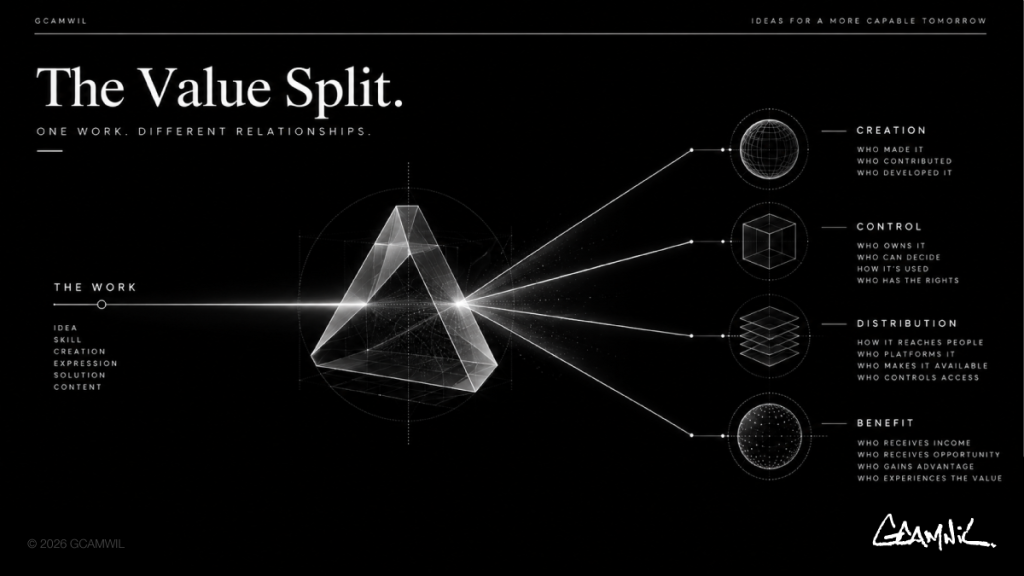
But once you look a little closer, there are a few different questions worth asking. Who created it? Who has the legal right to use it? Who decides how it reaches people? Who receives the money or other benefits it generates?
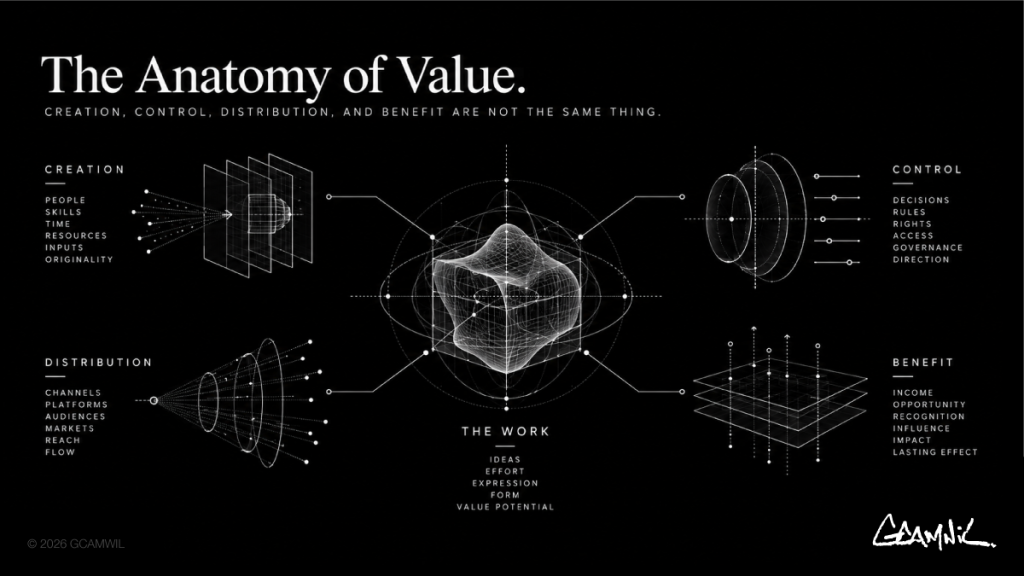
Sometimes one person has a say in all those things. Quite often, they don’t.
You might own the copyright in a photograph and still struggle to find a buyer. You might get paid well for work that becomes part of your employer’s business. Or you might own a product but depend on another company to sell it.
Different arrangements create different possibilities.
The law can determine who owns certain kinds of work from the start. Contracts can also establish who has which rights and responsibilities. And even when ownership is clear, financial benefit can depend on demand, distribution, resources, and negotiating power.
So making something doesn’t automatically tell you how much control you have over it. Neither does having your name attached to it. And even owning the rights may not give you much practical control if you have no way to exercise them.
That’s why our conversation about independence needs to go further.
The creator economy has made it possible for more people to create without first convincing an established institution to give them an opportunity. But creating independently doesn’t mean you stop depending on others.
You still need ways to reach people, relationships that make the work useful, and, if you’re trying to earn a living, a way to turn that value into income. The difference is that you may have more arrangements to choose from.
And once you start seeing how these arrangements work, you begin asking a different question.
It isn’t simply whether somebody else benefits from something you made. It’s what each of you contributes, what each of you receives, and whether the exchange makes sense.
The Value of the Exchange
I can see why someone might hear all this and think the answer is pretty simple. If you create something valuable, you should own it.
I get the appeal. Especially when you hear about someone coming up with an idea that eventually makes a company millions of dollars, while the person who contributed it receives very little of that success. You hear a story like that and think, well, somebody got the short end of the stick.
Maybe they did. But knowing who owns what doesn’t tell us enough to decide whether the deal was fair.
Think about what a company provides when it hires someone. There’s the salary, of course. But there’s also equipment, software, colleagues, access to customers, and an operation somebody has to keep running.
The employee brings their abilities and judgment. The company brings resources and handles responsibilities the employee might never have to deal with directly. And when something goes wrong, the employee isn’t necessarily the one financing the loss.
None of that automatically makes the arrangement fair. People can be underpaid, overlooked, or excluded from decisions that affect their work. But just because a company benefits from someone’s work doesn’t tell us whether the arrangement was fair.
We need to know what both sides contributed.
I think about this because of my work through CEREBRUM. When someone hires my agency, they’re usually trying to solve a business problem. Maybe they need a stronger brand. Maybe a campaign isn’t performing as expected. Or maybe they need a better way to reach customers.
They’re not asking me to become a partner in their entire business. They need something done, and they need it done well.
My job is to figure out what they’re trying to accomplish, bring the right skills and resources, and deliver something that actually helps. In return, they compensate the agency and provide the information, resources, or access needed to do the work.
That’s the exchange.
And if the work helps their company succeed, that doesn’t automatically mean I should own a percentage of everything that happens afterward. I agreed to provide a service.
But the opposite can also be true.
Just because someone is willing to pay you doesn’t mean the opportunity is worth accepting. You have to consider the work involved, the compensation, the responsibilities you’re taking on, and whether you’re giving up something that could become more valuable later.
A project can make money and still not be worth your time. You can stay busy, keep getting paid, and still have little room for anything else.
Sometimes you don’t recognize the real cost of an opportunity until you’re already committed.
And this doesn’t only happen with employers or clients. Think about someone earning most of their income through a digital platform.
That platform might provide an audience, distribution tools, payment systems, and technology they couldn’t afford to build themselves. Those things are valuable. Accepting certain rules or limitations in exchange for that access might make sense.
But what happens when almost all of someone’s income depends on that relationship?
The platform changes how people discover their work. Or it adjusts its fees, rules, or requirements for earning money. Suddenly, their income changes even though the quality of their work hasn’t.
They might understand what’s happening. They might even know they’d be better off with other options. But what happens if they can’t afford to leave?
That’s the part of this conversation that deserves more attention.
We tell people to know their worth, negotiate better terms, or stop giving away their work. Sometimes that’s useful advice. Knowing what your work is worth doesn’t automatically put you in a position to negotiate.
Someone who needs their next paycheque to cover the bills isn’t negotiating from the same position as someone with savings and several offers to consider. A freelancer who depends on one major client has different options from someone with several reliable clients. And a creator whose income depends on one platform can’t necessarily replace that audience simply by deciding they want more independence.
That doesn’t mean they’re not ambitious or don’t know what’s going on. They have different levels of bargaining power. And that depends a lot on the options you have before you even sit down to negotiate.
If you can afford to turn down a project, you can consider its terms differently. If your skills are useful across several industries, losing one opportunity doesn’t necessarily leave you without income. If you can maintain relationships with readers or customers across different services, a change on one platform might affect you less severely.
None of that guarantees success. Building alternatives takes time. Some relationships are much harder to leave than others. But having alternatives changes the decisions you can realistically make.
That’s why I hesitate when people talk about economic independence as though the answer is to own everything.
Ownership can be valuable. It can give you rights, options, and the possibility of benefiting from something long after the original work is finished. But it can also leave you responsible for finding customers, maintaining the product, covering expenses, and absorbing losses.
Meanwhile, someone who gives up certain rights in exchange for reliable compensation might gain the stability and freedom to focus on work they enjoy. Neither arrangement automatically tells us how much agency someone has.
You have to look at the circumstances. What are they contributing? What are they receiving? What risks are they carrying?
And perhaps most importantly, what could they realistically do if the arrangement stopped working?
Because I don’t think the objective is to eliminate every dependency. Most valuable work involves other people. It involves relationships, shared resources, and some kind of exchange.
What matters is understanding which relationships help you do meaningful work, what they require from you, and how much room they leave you to make decisions about your future.
Sometimes keeping ownership makes sense. Sometimes selling the work, licensing it, collaborating with someone, or contributing to a larger organization is the better decision.
The point isn’t to own everything. It’s to understand what you’re giving up, what you’re getting in return, and what becomes possible because of that decision.
What Can You Actually Keep?
I’ve spent a good part of my career helping other people build things. Brands. Campaigns. Websites. Creative work that became part of someone else’s business.
Sometimes I’d finish a project and move on. Other times, I’d work with the client for years. Either way, I was helping build a business that wasn’t mine. And when the terms made sense, I was fine with that.
These days, I’m spending more time building and publishing work under my own name. Essays, artwork, ideas, and a growing body of knowledge I’m developing over time.
I’m still using many of the same skills. I’m still creating things other people might find useful. But I’ve been thinking more about what happens to that work once it’s out in the world.
Who gets to use it? Where does it go? What opportunities might it create? And what relationship will I have with it five or ten years from now?
I don’t have all those answers. But asking the questions has changed how I approach the work.
The more I think about how people work, create, and earn a living, the more obvious it becomes that there’s no single arrangement that works for everybody.
You can make something extraordinary and receive exactly what you agreed to receive. You can own something valuable and struggle to find anyone willing to pay for it. You can build an audience through a platform that helps you reach thousands of people, even though you have little say over how it operates. And you can make a good living without owning every asset your skills help create.
None of those situations tells you everything you need to know. What matters is understanding what you’re participating in, what you’re receiving, and what happens if the circumstances change.
And that’s what I think matters when we talk about independence.
We’ve spent years celebrating the fact that more people can create, publish, teach, and build without waiting for somebody to give them an opportunity. And that’s worth celebrating.
But having the chance to begin doesn’t mean you get to decide everything that happens afterward. And owning something doesn’t necessarily give you the resources or influence to do whatever you want with it.
Your options might depend on the relationships you’ve built, the resources you have, your reputation, or whether you have somewhere else to turn when things don’t go as expected.
You don’t need to own everything. But it helps to understand what you’re agreeing to, what you’re depending on, and how much freedom you have to make a different choice.
Not everyone needs to start a business to do that. And not every creative pursuit needs to become a product.
Some of the most valuable things we’ll ever contribute will be created alongside other people, inside organizations, or simply because we wanted to make something worthwhile. There’s nothing wrong with that.
But wherever your work ends up, it’s worth knowing what your relationship to it actually is.
Because creating something valuable is one kind of power. Having a meaningful say in what happens to that value is another.
So the next time you make something valuable, ask yourself:
What do I receive? What do I retain? And what choices does that leave me?
Garett
PS: Know someone who would benefit from this? Send them this link → subscribe.garettcampbellwilson.com
Want more insights on mastering the creator economy? Follow me on Instagram @gcamwil and stay updated on the latest strategies.
Start Here: The Digital Renaissance Manifesto
The system wasn’t built for creators. The traditional career path is collapsing, and the future belongs to those who create, not just those who comply. But how do you transition from being trapped in the old system to thriving in the new one?
That’s exactly what I break down in The Digital Renaissance Manifesto: your essential guide to understanding how creativity, technology, and ownership are merging to create the biggest wealth shift of our time.
Read The Digital Renaissance Manifesto – If you’re ready to stop trading time for money and start building leverage, this is where you begin.
Keep Learning: Related Reads
- YOU DON’T NEED A PERSONAL BRAND. UNTIL YOU NEED ONE.: How to package your knowledge, point of view, or process into digital assets that don’t expire when your shift ends.
- HOW TO TAP INTO THE WEALTH TRANSFER NO ONE TALKS ABOUT: There’s a silent wealth transfer happening. It’s happening in human attention.
- THE 9 TO 5 IS DEAD. NOW WHAT?: Why some are waking up to the fact that relying on a single employer for financial security is too risky.