

For years, I thought I was keeping records.
Project notes. Annual reviews. Research threads. Journals. Conversations worth remembering. Short briefs documenting decisions I’d made, problems I’d solved, things I’d tried, and what happened afterward.
Most of it started for practical reasons. I wanted continuity. If I came back to a project six months later, I wanted to know why I’d made a particular decision instead of trying to reconstruct the logic from scratch. I also wanted some protection against that strange human tendency to forget things that once seemed impossible to forget.
But earlier this year, I started looking across the archive differently.
A problem I’d solved while building my company would reappear years later as a principle I could use somewhere else. Something I’d learned making art would explain the way I approached writing. A failed experiment would leave behind a warning. Something I’d improvised because I needed a solution would eventually become a repeatable method.
Things that had seemed unrelated while I was living them started connecting once I could see them beside one another. The records were preserving events, but the events had been producing something.
That changed the way I approached my annual review. Normally, the exercise is retrospective: What happened this year? What did I accomplish? What changed? What went wrong?
This time, I asked myself a different question:
What permanent knowledge emerged this year?
That question changed the archive.
A conversation might contain a distinction I’d still need five years from now. A mistake might have purchased a warning I shouldn’t have to buy twice. A project didn’t disappear when it ended if the process left behind a method. Even an abandoned idea could contain something worth carrying forward.
That’s when I realized I wasn’t only keeping a record of my life.
I was accumulating raw material.
And that raised a slightly uncomfortable question: if all of this knowledge had been forming while I was busy living, how much of it would’ve disappeared if I’d never stopped to look for it?
I suspect you probably have considerably more experience than you’ve extracted knowledge from, too. You remember the job, the project, the failure, the strange year, the thing you tried that worked, the thing you swore you’d never do again. Some of those experiences changed the way you make decisions. Some changed what you notice. Some taught you lessons you can explain clearly. Others may have disappeared so completely into your judgment that you no longer recognize them as things you had to learn.
You know what happened.
But knowing what happened and knowing what it taught you are two different things.
And that’s the distinction I want to explore, because experience by itself isn’t the asset. You can live through something and misunderstand it. You can repeat the same mistake for years and call it experience. You can remember an event accurately enough and still draw the wrong conclusion from it. Even reflection, as useful as it is, doesn’t automatically turn the past into wisdom.
So the interesting question isn’t simply how much experience you’ve accumulated.
It’s what your experience has left behind.
What did those years teach you that you can still use? How do you tell the difference between a lesson worth keeping and a story you’ve simply repeated enough times to believe? And what has to happen before something you learned in one moment can become useful in another?
That’s where I think the idea of experience as an asset becomes much more interesting.
I’m not talking about turning your entire life into content, packaging every difficult experience into a lesson, or pretending that everything you’ve lived through contains some hidden business opportunity. Some things should remain private. Some experiences won’t produce anything useful. Some lessons will eventually turn out to be wrong.
What interests me is something more fundamental: whether the knowledge you’ve already paid for can survive the circumstances that produced it.
Because if it can, your past becomes more than something you remember. It becomes something you can study, question, refine, carry forward, and sometimes use somewhere completely different from where you learned it.
And by the end of this, I want to show you why that distinction matters. Why years of experience don’t automatically make us wiser. Why some of your most valuable knowledge may be the hardest for you to recognize. Why the first lesson you take from an experience may not be the right one. And, ultimately, what has to happen before something that happened to you becomes something your future can use.
Because you may already possess more valuable knowledge than you realize.
The question is whether you’ll recognize it before the lesson disappears.
We Count the Years
We say we value experience all the time.
We ask how long someone has worked in an industry. We count the positions they’ve held, the companies they’ve built, the projects they’ve completed, the credentials they’ve earned. A résumé is basically a chronology of accumulated experience: five years here, three years there, another title, another responsibility, another line proving that time was spent doing something.
But time spent tells us surprisingly little about what that time actually produced. Someone can say they have fifteen years of experience, but what accumulated during those fifteen years? What can they recognize now that they couldn’t recognize before? Which mistakes no longer fool them? Which questions have they learned to ask? Which decisions have become easier because they’ve already seen some version of the problem?
We’re good at counting experience. We’re much worse at accounting for what it produced.
And I think part of the problem is that we tend to imagine valuable knowledge as something we still need to acquire. It’s somewhere ahead of us. In the next book. The next course. The next mentor. The next job. The next credential. The next decade of practice.
Formal learning makes knowledge easy to recognize because you remember learning it. There was a teacher. A book. A classroom. A tutorial. A syllabus. Maybe a certificate at the end confirming that, yes, you’d officially learned something.
Experience doesn’t usually give you a certificate.
You learn while trying to keep a project alive. You learn after saying the wrong thing in a conversation. You learn when the strategy that looked perfect on paper runs headfirst into reality. You learn after making the same kind of mistake enough times that you finally recognize its shape. You learn by watching people, making things, solving problems, taking risks, recovering from bad decisions, and paying attention to what happens next.
There was a time when you couldn’t see what you see now. Something happened between then and now. You made decisions. You saw outcomes. You missed signals. You corrected mistakes. You paid attention.
What feels obvious to you may only feel obvious because you paid the tuition of experience.
The problem is that experience doesn’t hand you an itemized receipt afterward. It doesn’t tell you: Here are the five distinctions you learned. Here are the three mistakes you no longer make. Here is the judgment you developed. Here is the pattern you can now recognize ten minutes earlier than you could five years ago.
You just keep living. Somewhere along the way, things that once required effort become obvious.
And maybe that’s why so much of what we learn becomes difficult to value. You can point to the years. You can describe what happened during them. But how often do you stop and identify exactly what those years left behind?
Which creates a strange possibility:
Some of what you’ve learned may have become so familiar that you no longer recognize it as something you had to learn at all.
You Know More Than You Can Tell
Some lessons eventually stop feeling learned.
They become perception.
An experienced designer can look at a composition and know something is unbalanced before they can explain exactly why. A founder can hear something in a prospective client’s answer that changes the direction of the conversation. A writer can read a sentence and know it’s dead. A cook can look at a pan and know it needs another minute.
The judgment arrives before the explanation.
The philosopher Michael Polanyi gave us a useful way to understand this. His work on tacit knowledge argued that we can possess meaningful knowledge we can’t fully articulate. Knowledge can become embedded in practice, judgment, perception, and learned ways of seeing until using it becomes easier than explaining it.
We tend to recognize knowledge by our ability to state it. If you can define it, write it down, teach it, or explain it clearly, it looks like knowledge. But experience doesn’t always work that way. Sometimes you get better at doing something long before you get better at explaining what you’re doing.
Think about how much of your life works like this. You learn to recognize when a conversation is going somewhere dangerous. You get better at telling the difference between someone who’s genuinely interested and someone who’s wasting your time. You become more realistic about how long a project will actually take. You develop instincts about whom to trust, when to push, when to wait, which details matter, and which problems are symptoms of something deeper.
Creative work is full of this kind of knowing. So are leadership, negotiation, entrepreneurship, collaboration, and even taste.
And here’s the strange part: you may not remember the individual experiences that taught you any of it. There probably wasn’t one conversation that taught you how to read people, one project that taught you how long projects take, or one mistake that created your judgment. Hundreds of small encounters accumulated until the lesson stopped feeling like a lesson.
It became the way you see.
That’s what makes experiential knowledge so easy to misclassify. What was learned starts feeling obvious. What came from pattern recognition starts feeling like instinct. What was purchased through years of mistakes starts feeling like personality. What began as experience disappears into the way you see.
Once that happens, you start underestimating the knowledge itself. You assume everybody notices what you notice. You skip steps when explaining something because those steps have become automatic. You forget how long it took to develop a judgment because you can barely remember what it felt like not to have it.
It’s one reason experienced people sometimes struggle to teach beginners. The beginner needs an explanation for something the experienced person no longer consciously thinks about. But the problem is bigger than teaching. If you can’t see the knowledge your experience produced, you can’t examine it very well either. You can’t easily preserve it, connect it to other things you know, challenge it, refine it, or deliberately use it somewhere new.
And this is where your past starts changing categories.
A failed project is no longer only a failed project. It’s evidence. A decade in an industry isn’t merely elapsed time. It’s a possible collection of patterns. An old obsession may have trained your eye. A difficult period may have changed your judgment. A series of mistakes may have taught you something you now perform automatically.
Your past starts looking less like a sequence of things that happened to you and more like a body of evidence you can study.
That’s a powerful realization, but here’s where I think the idea gets dangerous. Once you realize experience has been teaching you all along, it’s easy to make one more leap:
Whatever experience taught me must be true.
It isn’t.
Experience Can Teach You the Wrong Thing
There is a dangerous version of the idea that experience is valuable:
I lived it, therefore I understand it.
But those aren’t the same thing.
You can spend twenty years repeating the same mistake. Success can produce insight, but it can also produce superstition. A painful relationship can teach you to recognize a genuine warning sign, or convince you that everyone who reminds you of the person who hurt you should be treated with suspicion. One lucky decision can become a strategy. One unusual outcome can become a theory about how the world works.
Experience gives us evidence. We still have to figure out what the evidence means.
This is one reason years of experience and actual expertise aren’t interchangeable. Research into expert performance has spent decades trying to understand what separates accumulated exposure from genuine improvement. The details are still contested, but the useful point is simpler: time alone doesn’t guarantee mastery. Practice matters. Feedback matters. Adjustment matters. Context matters.
Ten years can contain ten years of learning, or the same year repeated ten times.
Time served is not the same as understanding earned.
So experience alone isn’t enough. We need some way to go back and examine what happened.
That’s where reflection enters.
An experience happens once. Reflection lets you return to it with questions you may not have been capable of asking while you were inside it. What did I expect to happen? What actually happened? What did I miss? What repeated? What part did I play in the outcome? What would I do differently now?
Donald Schön spent much of his work examining this kind of reflective practice: how people think while they’re acting and how they return to their actions afterward to understand what their practice was teaching them. Research since then gives us good reason to take reflection seriously as part of learning.
But reflection doesn’t solve the problem completely. You can reflect on an experience and still be wrong about it.
Reflection is a learning mechanism. It is not a truth machine.
We’re perfectly capable of reflecting our way into an explanation that makes us look good. We protect our identities. We rationalize bad decisions. We assign motives to people we could never actually know. We look backward with information our earlier selves didn’t have and tell the story as though the outcome should’ve been obvious all along.
And memory makes the whole thing even messier. Autobiographical memory isn’t a perfect recording sitting somewhere in your mind waiting to be replayed. Research describes remembering as reconstructive. What you remember can be influenced by later information, current beliefs, existing mental models, and the person you’ve become since the original event.
So whenever you study your own life, you’re dealing with at least three different things:
What happened. What you remember happening. What you now believe it meant.
Those can overlap considerably, but they’re not the same thing.
This is one reason I’ve come to value records for more than continuity. A note written while a project was failing can tell me what I actually believed before I knew how the story ended. An old journal can contradict the cleaner explanation I constructed years later. A decision log can preserve variables my memory quietly removed.
Documentation doesn’t make autobiography objective. It gives reflection more evidence to work with.
Reflection does not recover a perfect past. It interrogates the evidence that survived it.
But even if your memory is reasonably accurate, there’s another problem: something can be true about your experience without being true about the world. One bad partnership doesn’t prove that partnerships fail. One successful launch doesn’t prove the strategy will work again. One creative breakthrough doesn’t establish a universal creative process.
Your experience can give you a reason to investigate something. It doesn’t automatically give you permission to turn it into a law.
So I think the first lesson you extract from an experience is probably better treated as provisional. You reflect on what happened. You form an explanation. Then you take that explanation back into the world and see what happens.
Does the pattern appear again? Does the principle survive different conditions? Does new evidence contradict it? Does applying the lesson improve your judgment, or show you something you missed the first time?
You reflect on the experience, extract a provisional lesson, apply it somewhere new, and allow what happens next to refine what you think you know.
Reality gets another vote.
Before something deserves to become knowledge, you give the world another chance to disagree with you. Maybe the lesson survives. Maybe it needs another variable. Maybe you had the entire thing backward.
The goal isn’t to become better at defending the stories you tell about yourself. It’s to become better at learning from them.
Once you see the process this way, the question is no longer whether having experience automatically makes you wiser. It doesn’t. The more interesting question is what happens when something useful survives the experience, survives your interpretation of it, and then survives another encounter with reality.
Because if the lesson can do that, we can finally ask a much more interesting question:
What can this knowledge do now?
Make the Past Useful
If experience is raw material rather than finished wisdom, the task isn’t to worship your experience. It’s to process it.
By now, we’ve eliminated most of the shortcuts. Experience alone doesn’t make you wise. Time doesn’t guarantee expertise. Reflection helps, but you can reflect your way into a story that happens to be wrong. Memory gives us evidence, not a perfect recording. Even the lessons we extract deserve another encounter with reality before we decide they’re worth keeping.
So here’s the practical question:
What has to happen for something you lived through in the past to become useful in the future?
The larger conversion looks like this:
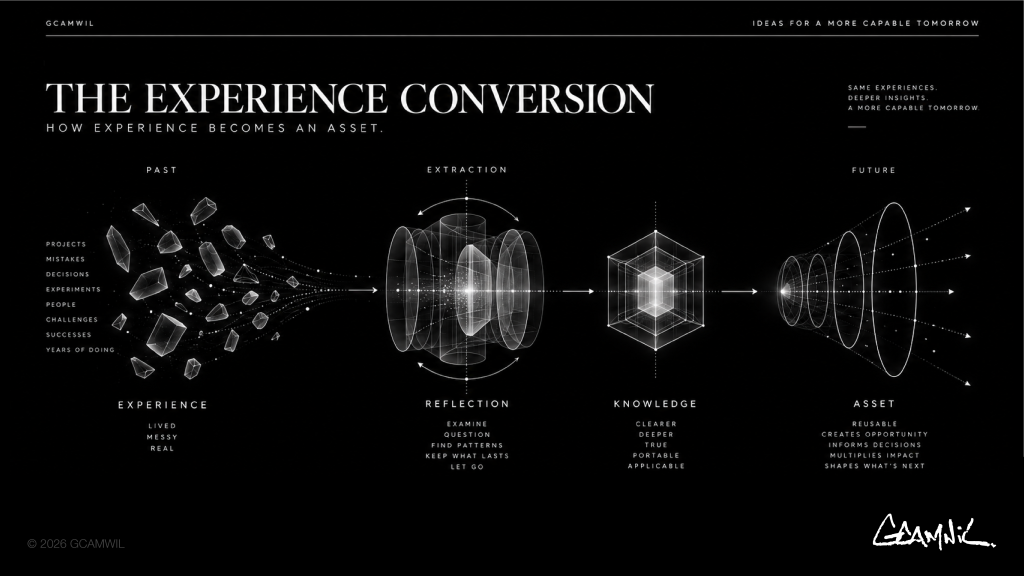
Experience is where the process begins.
What happened?
Before deciding what something meant, start with the event. What did you do? What happened next? What did you expect? What surprised you? What changed afterward? It sounds almost too simple, but there’s a reason to begin there. The faster you rush toward meaning, the easier it becomes to confuse the event with the story you’ve built around it.
Then comes reflection.
What did it reveal?
Now you can interrogate what happened. What did you miss while you were inside it? Which assumptions did you bring with you? What repeated from earlier experiences? What part did you play in the outcome? Is there another explanation that fits the evidence better?
Reflection turns history into something you can examine. But the first lesson you pull from an experience still isn’t automatically knowledge. It has to survive comparison, contradiction, application, and new experience.
So knowledge asks a harder question:
What remains useful beyond the event?
This is where the lesson has to travel.
David Kolb’s work on experiential learning describes a related process. Experience becomes material for reflection. Reflection contributes to conceptual understanding. Those concepts return to action, where they encounter reality again. The important point isn’t simply that you had an experience. It’s that the experience was transformed into something you could use.
You notice a pattern in one project, then see it again in another. You put language around what you think is happening and try the principle somewhere new. Maybe it works. Maybe reality exposes a variable you missed. You adjust it.
Eventually, the lesson becomes less dependent on the original story that produced it.
You can carry it somewhere else.
And that’s where the word asset starts to make sense.
Where can that knowledge create future value?
A mistake can become a warning that prevents another mistake. A difficult project can produce a process that makes the next project easier. Years of creative practice can become judgment that improves the next piece of work. A recurring observation can become a principle. A solution you keep reinventing can become a method. A collection of related lessons can become a framework.
Something you learned the expensive way might even help someone else avoid paying the same price. Some forms of accumulated knowledge can eventually become stories, teachings, methodologies, systems, or intellectual property.
But I think we make the idea unnecessarily small if we measure that value only in money.
A lesson that changes how you choose a collaborator has created value. A principle that helps you recognize when to leave a bad situation has created value. A piece of judgment that saves you six months on the next project has created value. A creative insight that changes the next painting has created value. A warning that stops your future self from repeating an old mistake has created value.
So here’s the definition I’ve found most useful:
Experience becomes an asset when knowledge extracted from the past can improve something that has not happened yet.
The past has acquired future utility.
Once I understood that, I understood what I’d actually been building with all those records. The Annual Knowledge Harvest wasn’t valuable because I could preserve everything that happened to me. I don’t need to preserve everything. Most of us probably shouldn’t. The archive was valuable because it gave patterns somewhere to become visible, lessons somewhere to survive, and me a way to notice when something that happened years ago was still producing value today.
There’s a boundary here that matters. Studying your life doesn’t mean commodifying it. Not every experience should become an essay. Not every private struggle should become content. Not everything you learn needs to become a lesson for strangers. Some knowledge can remain private and still change the way you live.
The point isn’t to turn your entire existence into intellectual property. It’s to become more conscious of what your existence has taught you.
Because the asset was never the event itself.
The asset is what the event can continue producing after it is over.
Don’t Let the Lesson Disappear
Eventually, almost everything that produced the lesson will end.
The project ships. The job changes. The company evolves. The collaboration ends. The creative period passes. The problem that consumed your attention for six months gets solved and replaced by another one. Even your memory of it changes.
That’s why the records I described at the beginning matter to me differently now. Their value isn’t that they prove how much happened. I don’t need an archive to tell me I was busy, and most events don’t deserve to be preserved simply because I lived through them.
What matters is what survives.
A question. A warning. A distinction. A principle. A method. A story. A piece of judgment that wasn’t there before. Those things can look surprisingly small compared with the experiences that produced them. A lesson might fit into a single sentence even though acquiring it took years.
But that’s part of what makes it valuable. The project can end while the method remains. The mistake can recede while the warning remains. The collaboration can end while the understanding remains. The circumstances that taught you something don’t have to repeat for the knowledge to become useful again.
Once you see it that way, your past and your future start having a different relationship.
Your past has already paid for certain lessons.
It paid in time, attention, failed attempts, wrong turns, awkward conversations, money lost, work discarded, opportunities missed, experiments that went nowhere. Sometimes the price was small. Sometimes it was enormous.
The question is whether you want to keep paying for the same lesson.
If the lesson disappears with the event, the next version of you may have to learn it all over again. You can make the same kind of mistake in a completely different situation, rebuild a process you figured out three projects ago, or walk into a problem you’ve seen before without recognizing its shape.
But if something useful survives, if you’ve examined it, tested it, put language around it, and found some way to remember it, then your future inherits something your past had to earn.
That’s where experience begins to compound.
What compounds isn’t age or the accumulation of stories. Living longer doesn’t automatically make you wiser, and every conclusion you draw from your life doesn’t deserve to become a principle. What compounds is the knowledge that survives scrutiny and remains useful after the circumstances that produced it are gone.
That’s what I see now when I look across those records: not a perfect account of what happened or a monument to everything I’ve done, but a body of evidence.
Some of it will turn out to mean less than I thought. Some lessons will need revision. Some ideas will become obsolete. Some experiences will remain private. Some things will deserve to be forgotten.
But every so often, something durable emerges. Something I can use again. Something I can carry into another domain. Something I can give to another person. Something my future self doesn’t have to learn from zero.
And maybe that’s the simplest way I can explain what changed for me.
I used to think the value was in having the experience. Now I think the value is in what survives it.
That’s when experience becomes an asset.
Not because the experience happened, but because what it taught you didn’t disappear when it ended.
A life does not compound because it gets longer. It compounds when its lessons stop disappearing.
Garett
PS: Know someone who would benefit from this? Send them this link → subscribe.garettcampbellwilson.com
Want more insights on mastering the creator economy? Follow me on Instagram @gcamwil and stay updated on the latest strategies.
Start Here: The Digital Renaissance Manifesto
The system wasn’t built for creators. The traditional career path is collapsing, and the future belongs to those who create, not just those who comply. But how do you transition from being trapped in the old system to thriving in the new one?
That’s exactly what I break down in The Digital Renaissance Manifesto: your essential guide to understanding how creativity, technology, and ownership are merging to create the biggest wealth shift of our time.
Read The Digital Renaissance Manifesto – If you’re ready to stop trading time for money and start building leverage, this is where you begin.
Keep Learning: Related Reads
- YOU DON’T NEED A PERSONAL BRAND. UNTIL YOU NEED ONE.: How to package your knowledge, point of view, or process into digital assets that don’t expire when your shift ends.
- HOW TO TAP INTO THE WEALTH TRANSFER NO ONE TALKS ABOUT: There’s a silent wealth transfer happening. It’s happening in human attention.
- THE 9 TO 5 IS DEAD. NOW WHAT?: Why some are waking up to the fact that relying on a single employer for financial security is too risky.