

I spent the first part of my life thinking creativity was something you could hold in your hands. A pencil. A brush. A camera. A sheet of paper. A finished image hanging on a wall. That was the territory I understood.
I went to art school and studied visual communication. I learned composition, perspective, typography, photography, design, and the strange discipline of taking something that existed only in your head and making it visible enough for another person to experience. The tools were physical. The outputs were recognizable. The boundaries around what counted as creative work seemed relatively clear.
Then the things I was making started to change.
Paintings became spreadsheets. Sketchbooks became databases. Studio habits became operating systems. I started building businesses, publications, educational programs, archives, workflows, intellectual property, and increasingly elaborate digital systems. The strange thing was that work I never would’ve called creative when I was younger kept demanding the same instincts I’d spent years developing in the studio: composition, hierarchy, iteration, judgment, pattern recognition, restraint.
For a while, I thought this meant I’d moved away from art. Eventually, I realized almost the opposite had happened.
The canvas got bigger.
And I mean that more literally than it probably sounds. The number of things I could plausibly make had expanded.
A laptop gave me access to forms of production that once belonged to entirely different professions. The internet gave the things I made somewhere to travel. Digital platforms gave me places to publish them. Cloud software gave me infrastructure I didn’t have to build or own. The phone in my pocket became a camera, editing suite, research terminal, communications system, storefront, publishing device, and connection to people almost anywhere.
Then artificial intelligence pushed the perimeter outward again. Things that once required more time, more technical knowledge, or another person could sometimes be attempted in an afternoon. A missing skill didn’t necessarily stop the project anymore. I could investigate the problem, work alongside the tool, learn enough to get moving, and discover the next limitation somewhere further down the road.
That’s the part that interests me more than the novelty of the technology.
I was still me. I hadn’t suddenly become a programmer, researcher, publisher, designer, strategist, educator, and operator because software could help me perform pieces of those jobs. Expertise still mattered. Other people still mattered. What had changed was how far I could get before another person or institution necessarily had to become involved.
Somewhere along the way, the distance between imagining something and being able to act on it got shorter.
Once I noticed that happening in my own life, I started seeing versions of it everywhere. A teenager could publish to a global audience from a bedroom. A teacher could build a classroom without a school building. A musician could record without owning a studio. A small business could sell beyond its neighborhood. Someone who’d spent twenty years becoming unusually good at something could turn that experience into writing, education, media, software, or intellectual property. A person with an idea could reach tools, information, markets, and collaborators that would’ve been extraordinarily difficult to assemble not very long ago.
That didn’t mean any of it would work. The teenager might publish something nobody watches. The business might open a storefront nobody buys from. The musician might make a terrible record. You can have access to extraordinary tools and still lack the skill to use them, the judgment to know what to make, or the resources to keep going long enough for any of it to matter.
But increasingly, you could begin.
I kept coming back to that word because it suggested the technological story I’d been watching was larger than the machines themselves. We spend enormous amounts of time asking what computers can do now, what AI will be able to do next, which professions will change, which industries will disappear, and which new technology is about to rearrange the world.
Those are important questions. But they’re mostly questions about the technology.
The question underneath them is about us:
What has all of this changed about what a person can do?
When Permission Made Sense
Looking backward from the internet, it’s easy to tell ourselves a very clean story about gatekeepers.
Publishers decided who became authors. Television networks decided what reached millions of homes. Record labels decided which musicians received serious distribution. Universities certified expertise. Galleries selected artists. Employers controlled access to equipment, customers, professional networks, and careers.
Some of those systems were exclusionary by design. Gatekeepers could be biased, conservative, self-interested, or simply wrong. Extraordinary people were overlooked. Entire groups were systematically denied opportunities available to others.
But if we reduce the old system to powerful people refusing to let everyone else participate, we miss something important.
They controlled infrastructure that was genuinely difficult to reproduce.
Think about what it once meant to broadcast something to millions of people. You needed equipment, technical expertise, access to limited spectrum, regulatory approval, production capacity, and an entire distribution infrastructure. You couldn’t solve that problem with more confidence.
Publishing had its own version of the same problem. You could always write something yourself. Turning that writing into thousands of physical objects, binding them, transporting them across a country, placing them in stores, marketing them, collecting payment, and getting them into the hands of readers was an entirely different undertaking.
Human beings didn’t suddenly acquire agency when the internet arrived. We’ve always made things without being asked. We started businesses, built communities, published pamphlets, organized movements, invented technologies, created art, taught one another, crossed oceans, and formed institutions of our own.
The human impulse to act is ancient.
What changed was the infrastructure surrounding that impulse.
For much of modern economic life, there were things an individual could imagine but couldn’t easily execute alone. The limiting factor wasn’t always courage or creativity. Sometimes the problem was painfully practical. You didn’t own the printing press. You didn’t have a broadcast tower. You couldn’t afford the recording studio. You didn’t have a factory, a server, a distribution network, specialized equipment, enough capital, the right credential, or access to the people who did.
Institutions solved that problem by assembling resources individuals usually couldn’t assemble themselves. Once valuable infrastructure became concentrated inside institutions, those institutions naturally became gateways to whatever the infrastructure made possible.
Scarcity didn’t just make things expensive. It shaped the route to opportunity.
The old map looked something like this:
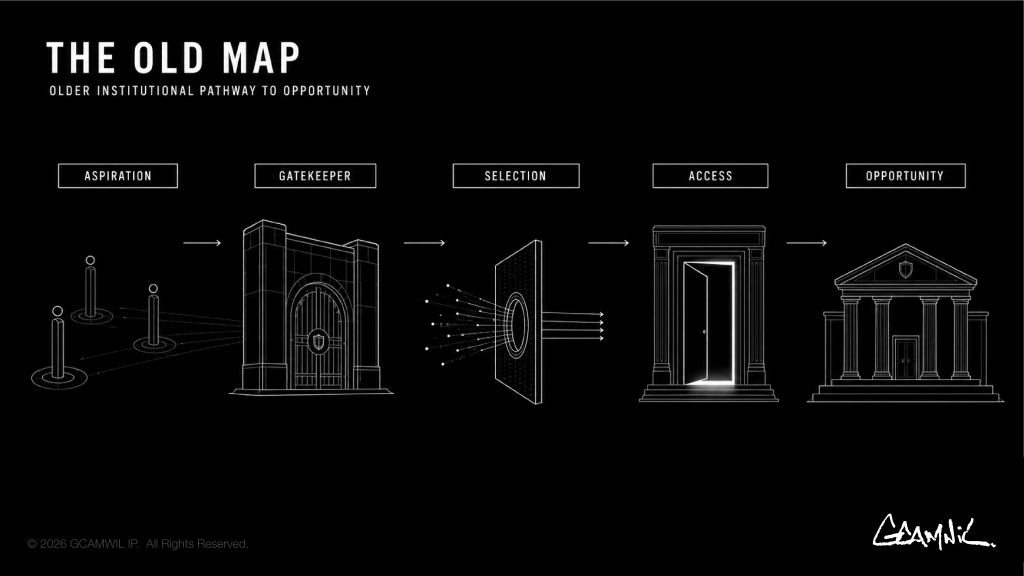
If you wanted the opportunity, you approached whoever controlled access.
That arrangement created power, and concentrated power always creates the possibility of abuse. But the gate wasn’t always there because somebody woke up that morning and decided to keep you out. A large part of it was structural.
Scarce infrastructure concentrated capability. Concentrated capability made permission valuable.
So people learned how to navigate that world. You asked who was hiring, who was publishing, who was funding, who was accepting applications, who was granting credentials, who was showing work, who could put your product on a shelf, who might finally give you a chance.
Those weren’t foolish questions. They were often exactly the right questions. If the machinery required to do something sat on the other side of an institution, getting through the institution was part of doing the thing.
Over time, that relationship did more than organize markets. It started organizing ambition. We learned familiar sequences for how serious things were supposed to happen: learn the approved material, earn the credential, apply for the position, get selected, enter the institution, gain access to its resources, move upward from there.
Creative ambition had its own version. Make the work and find the gallery. Write the manuscript and find the publisher. Record the demo and find the label. Develop the idea and find someone willing to fund it.
The institution stood between aspiration and scale.
This is why some of the contemporary language about “not needing permission” has always felt a little too easy to me. It treats permission-seeking as though generations of people were simply walking around waiting for somebody to believe in them because they lacked confidence.
Often, they were reading the environment correctly.
Permission-seeking was learned intelligence.
And learned intelligence travels. Parents teach it to children. Schools encode it into career pathways. Industries turn it into professional norms. Success stories reinforce it. Eventually, a practical response to a particular environment stops feeling like a response to an environment at all. It starts feeling like a rule about how opportunity works.
There’s nothing irrational about carrying a map that’s repeatedly gotten people where they needed to go.
The trouble starts when the terrain changes before the map does.
Technology can reorganize infrastructure remarkably quickly. The assumptions we inherit about who is allowed to initiate, where opportunity comes from, and what has to happen before serious work can begin tend to move more slowly.
Over the last several decades, the distance between those two things started getting wider.
While we were still carrying the old map, the infrastructure began moving closer to the individual.
The Distance Started Shrinking
The shift didn’t happen all at once. No single invention suddenly handed ordinary people the capabilities of institutions. It happened in layers. One technology removed a barrier. Another lowered a cost. Another made specialized infrastructure easier to reach. Eventually, things that used to live in separate buildings, professions, and organizations started showing up behind the same screen.
The personal computer brought production and calculation closer to the desk. The internet connected that desk to a network. Search made information easier to find. Digital publishing gave ordinary people somewhere to put what they made. Broadband increased what could move through those networks. Social platforms bundled publishing with distribution. Smartphones compressed cameras, communication, navigation, media production, computing, and internet access into something billions of people could carry. Digital commerce made it possible to sell without first securing physical retail distribution. Cloud computing let businesses rent technical infrastructure they once would’ve had to purchase and maintain themselves. Then artificial intelligence started pushing on a different boundary, closer to cognition itself.
Any one of those technologies is interesting. Stack them together and something much larger happens.
In 1975, the Federal Communications Commission described a media environment in which someone trying to reach a local mass audience reliably had two practical options: produce a written publication or acquire access to full-power broadcasting. Both came with high barriers to entry.
Thirty years later, Pew researchers were documenting teenagers producing and distributing media online. By 2003, more than 53 million American adults had already contributed some form of material to the internet.
Think about the distance between those two worlds.
The teenager didn’t suddenly become more creative than the television producer. The person publishing online didn’t acquire the editorial judgment of an experienced newspaper staff. Professional media didn’t stop mattering. What changed was how much machinery someone needed access to before they could put something into circulation. The audience was no longer limited to sitting at the receiving end of an institutional media system. Some of the audience could now reach across the same network and publish back.
The same pattern appeared in commerce. A storefront once meant securing a physical location, accepting payment on-site, carrying inventory, and depending heavily on geography. Digital commerce didn’t make the hard parts of business disappear. You still needed something worth buying. You still had to find customers, deliver what you sold, manage costs, and survive the rather inconvenient requirement of making more money than you spent. But you no longer necessarily needed a physical retail footprint before discovering whether somebody wanted what you had.
Cloud computing changed the threshold again. A software company no longer necessarily had to buy and maintain all the servers required to discover whether anyone wanted its product. Computing capacity could increasingly be rented as needed.
That sounds like a technical footnote until you look at what it does to experimentation.
If trying something requires a million dollars of infrastructure, relatively few people can try it. Bring the threshold down to ten thousand dollars and the field changes. Bring it down again and it changes again. The eventual company may still require serious capital, specialists, systems, and scale. But the company doesn’t have to exist at full size before the first version of the idea gets to meet reality.
That pattern keeps showing up.
The distance between having an idea and being able to act on it has been shrinking.
Not everywhere or at the same rate. But across enough domains that the cumulative effect becomes difficult to ignore.
Look at what can now sit behind one screen: research, writing, design, photography, video production, accounting, communication, project management, publishing, commerce, analytics, software development, distribution, education, automation. These are entire disciplines. Access to their tools doesn’t make anyone an expert in them. But pieces of their infrastructure can now be assembled by a person sitting at a kitchen table.
That changes the minimum scale at which something can begin.
I’ve come to think of this as the minimum viable institution.
An institution coordinates specialized capabilities. Someone researches. Someone writes. Someone designs. Someone handles operations. Someone distributes. Someone analyzes performance. Someone talks to customers. Traditionally, coordinating enough of those functions required an organization because the people, equipment, information, and infrastructure were scattered across different places.
Software keeps compressing the amount of organization required to coordinate pieces of that work. Sometimes the team becomes smaller. Sometimes the team becomes one person.
That doesn’t make one person equivalent to an institution. A laptop isn’t a multinational corporation because it has accounting software installed on it. Specialists, teams, capital, and organizational scale still become necessary. But the minimum infrastructure required to begin can be radically smaller than the infrastructure eventually required to succeed.
Artificial intelligence pushes directly against that boundary. In one study of 5,179 customer-support workers, access to a generative AI assistant increased issues resolved per hour by 14 percent on average, with much larger gains among novice and lower-skilled workers.
Another experiment involving consultants found that people using AI completed certain tasks faster and produced better-rated work when those tasks fell within the model’s capabilities.
But the second half of that experiment is more useful.
On a task deliberately chosen to sit outside the model’s capability frontier, consultants using AI were 19 percentage points less likely to reach the correct answer.
That’s a better picture of what these tools actually do. AI doesn’t hand someone unlimited capability. It changes the cost of attempting particular forms of work. Sometimes it accelerates production or helps someone cross a technical threshold. Sometimes it lets a novice perform closer to someone with more experience. Sometimes it gives you just enough assistance to make a much more sophisticated mistake.
AI starts looking less like a magical rupture and more like the newest layer in a longer story. The internet reduced certain distribution barriers. Search reduced certain information barriers. Cloud infrastructure reduced certain operational barriers. AI is beginning to reduce certain cognitive and technical barriers. Each layer changes how far someone can get before another person or institution has to become involved.
That’s where a story about technology becomes a story about agency.
When more of the infrastructure required for action moves closer to the individual, the range of things an individual can plausibly initiate moves with it. That’s what I’d been watching happen in my own work without having language for it.
The canvas hadn’t simply gotten digital.
The action surface had expanded.
There’s a very tempting conclusion to draw from that.
And it’s wrong.
Access Is Not Agency
There’s a tempting conclusion to draw from all of this: technology democratized everything.
The tools got cheaper. Publishing got easier. Information became abundant. Markets became more accessible. Artificial intelligence moved certain forms of expertise closer to ordinary people. Put enough of those changes together and it’s easy to tell a story in which everyone became more empowered.
The problem is that this skips almost everything between having access to a capability and being able to do something meaningful with it.
Owning a camera doesn’t make you a photographer. Having access to every tutorial on the internet doesn’t mean you know what to learn. Opening a social account doesn’t give you an audience. Having an online storefront doesn’t create demand. Using artificial intelligence doesn’t automatically improve your judgment.
The tool can become widely available while the ability to use it well remains scarce.
Access is not capability.
Put two people in front of essentially the same technology and they may possess radically different ranges of action. One sees a phone. Another sees a camera, publishing system, research terminal, storefront, classroom, communications network, and production studio. One opens an AI model and asks it a question. Another knows how to break a problem apart, provide context, interrogate the answer, combine the output with other tools, recognize when the model is wrong, and turn the result into something useful.
Same infrastructure. Different action surface.
And even capability isn’t agency.
You can know how to write and never publish. Know how to build and never begin. Recognize an opportunity and still refuse to move toward it. You can spend twenty years accumulating useful experience and never turn any of it into something another person can access.
Agency asks something more of us than having the tool or possessing the skill. At some point, you have to recognize that meaningful choice exists and exercise it.
But that becomes too neat if we only look at the person standing in front of the screen. The possibility itself is unevenly distributed.
Even now, about 2.2 billion people remain offline. Globally, roughly 85 percent of urban residents use the internet compared with 58 percent of rural residents. In low-income countries, only about one in seven rural residents is online.
Even in highly connected places, cost, disability, access to appropriate devices, education, time, and other material conditions affect whether nominal access becomes practical agency.
This is where conversations about agency can get sloppy. There’s a real difference between someone who could act but doesn’t and someone whose range of action is materially constrained. Collapse those two people into the same category and empowerment becomes a convenient way of blaming people for circumstances they don’t control.
But the opposite mistake doesn’t help either. Recognizing structural constraint doesn’t require pretending the expansion never happened.
The action surface expanded.
It expanded unevenly.
And underneath all of that sits another complication: the old gatekeepers didn’t simply disappear. Some of them moved.
You may no longer need a publisher to put writing into circulation, but a platform can still influence whether anyone sees it. You may not need to own computing infrastructure to build a digital product, but the servers underneath that product belong to someone. You may be able to sell directly to customers while depending on payment processors, marketplaces, search engines, app stores, logistics networks, and advertising systems you don’t control. You can use artificial intelligence to reach capabilities that once required more specialized labor while the computational infrastructure behind those systems remains concentrated in comparatively few hands.
Permissionless creation can coexist with permissioned infrastructure.
That distinction matters because agency isn’t sovereignty. Being able to initiate something isn’t the same as controlling every system required to sustain it. You can possess enormous creative agency on a platform you don’t own. Build a business on infrastructure someone else can change. Reach an audience through an algorithm you can’t inspect. Gain leverage from a technology whose future terms of access you don’t determine.
The capability is real.
So is the dependency.
This is one of the contradictions sitting at the center of the Digital Renaissance. Capability can move outward while infrastructure remains concentrated underneath it. Some gates disappear. Some become cheaper to cross. Some become optional. Some remain necessary. Others move so far beneath the interface that we stop noticing they’re gates at all.
That’s why I’ve never found “you don’t need permission anymore” particularly useful as a serious description of the moment.
Sometimes you absolutely do.
A doctor needs credentials. A pilot needs a license. A building needs permits. A company operating in a regulated industry can’t motivational-quote its way around the law. Sometimes permission isn’t technically required but remains extremely useful. You may not need a publisher to release a book, but the right publisher can still provide editing, distribution, legitimacy, capital, and reach that would be difficult to reproduce alone.
Then there are gates that really have become optional.
And stranger ones: gates we continue standing in front of mostly because we still expect them to be there.
The infrastructure around us can change faster than the mental models we built inside the previous infrastructure. For generations, people learned perfectly reasonable questions: Who will hire me? Who will publish me? Who will fund me? Who will certify me? Who will give me an audience? Who will choose me?
Those questions came from somewhere. They were shaped by a world in which meaningful infrastructure often sat on the other side of selection.
The mistake is assuming they’re still the only questions available.
There’s another one now:
What can I begin myself?
The answer isn’t everything. Agency doesn’t erase consequences, skill requirements, dependencies, unequal odds, or the need for other people. It means the territory has become complicated enough that treating every barrier as though it belongs to the same category no longer works.
Somewhere in that territory is the wall you can’t move. Somewhere else is the skill you haven’t learned yet. There’s a gate worth going through, another you can walk around, an institution that can make you stronger, a dependency you should understand, and probably at least one thing you’re perfectly capable of beginning while you wait for somebody to choose you.
A better map starts by learning to tell them apart.
Find the Territory You Can Act On
Once you see the terrain this way, agency stops sounding like a personality trait. It becomes a form of orientation.
I don’t think the useful question is whether you’re an “agentic person.” That turns agency into another identity to perform. The better question is whether you can look at the situation in front of you and tell the difference between what’s possible, what’s constrained, what you know how to do, what you still need to learn, and where your behavior hasn’t caught up with the options available to you.
That’s harder than confidence. Confidence can be wrong.
Agency requires a better map.
Permission is part of that map. What are you still waiting for someone else to initiate? Not because permission is always unnecessary. The question is whether the particular gate you’re standing in front of still performs the function you think it does.
Maybe you need the credential. Maybe you don’t need the publisher. Maybe employment is exactly the right structure for what you’re trying to accomplish. Maybe you can test the business before finding an investor. Maybe the institution gives you leverage you’d be foolish to reject. Or maybe you’ve spent three years preparing to be selected for something you could’ve started three years ago.
The point isn’t independence for its own sake. It’s accuracy.
Capability is another part. Where do you have access without competence? Removing a gate doesn’t download the knowledge that existed behind it into your head. A powerful tool in untrained hands is still a poorly used tool.
And sometimes the reason you can’t do something isn’t an institution, an algorithm, your mindset, or society.
You just don’t know how yet.
That’s useful information. It gives you somewhere to work.
Learning now sits inside the same expanding territory we’ve been talking about. Courses, lectures, papers, demonstrations, communities, software, archives, experts, and AI-assisted learning environments give us ways into capabilities that were once harder to reach. The question can increasingly shift from Who will train me? toward What do I need to learn next?
But capability creates a different problem. You can become extraordinarily good at doing things that have absolutely nothing to do with where you should be going.
And I think this may be one of the central paradoxes of the Age of Agency:
The more possibilities you have, the more important it becomes to know which ones deserve you.
When the available path is narrow, the environment makes a surprising number of decisions for you. When the path widens, those decisions come back.
What do you care about? What are you unusually equipped to notice? What kind of work do you want to become capable of producing? Which problems are worth years of your life? What do you want all of these skills, tools, relationships, and experiences to eventually accumulate into? And just as importantly, what are you willing to ignore?
A map becomes more important when there are more roads, not fewer.
This is why I keep returning to orientation before acceleration. You don’t need to pursue every possibility technology puts in front of you. You need enough understanding of yourself and the terrain to recognize which possibilities are actually yours.
Otherwise, expanded agency becomes expanded distraction.
You learn everything. Try everything. Chase every technological shift. Build whatever looks promising this month. Change direction whenever the environment produces another opportunity. You can spend years being extraordinarily active without staying pointed in one direction long enough for your actions to accumulate into anything.
Eventually, the freedom to choose becomes an inability to commit.
Agency requires selection. And eventually, selection has to become action.
Instead of asking how you’re going to build the entire thing, ask what you can initiate at a smaller scale than you’re currently imagining. Not the company, but the first customer conversation. Not the book, but the first page. Not the institution, but the first useful system. Not mastery of an entire discipline, but the next capability. Not the perfect body of work, but the next piece.
Not certainty.
An experiment.
There are things you can’t learn about an idea while protecting it from reality. You have to let the world touch it.
Make something and you discover whether you can finish it. Publish and you discover whether anyone responds. Attempt the skill and you find the edge of what you actually understand. Offer something and you discover whether another person values it. Build the prototype and suddenly the beautiful idea in your head has to survive contact with physics, customers, money, taste, time, or whatever else reality has been patiently waiting to tell you.
Action gives you something thinking eventually can’t: evidence. And evidence changes the map.
Maybe it tells you to continue. Maybe you need to improve. Maybe the idea needs to change. Maybe the whole thing was wrong and you should stop. All four outcomes leave you knowing something you couldn’t have known while standing still.
You don’t need to know the entire path. You need enough agency to make the next meaningful move.
This is also where our relationship with technology gets more interesting. The purpose of increasingly powerful tools can’t simply be to turn us into more efficient machines, maximize output because more output is possible, or automate every difficulty out of life.
Technology can widen the field.
It can’t tell us what deserves to occupy it.
So the useful question becomes much more human:
What does this new capability allow me to do that matters?
Sometimes the answer will be to build something yourself. Sometimes it’ll be to become better at work you’re already doing. Sometimes it’ll be to contribute more effectively inside an institution, teach what you know, organize people around a problem, care for someone, communicate something clearly, or make something that didn’t exist before.
Agency isn’t a mandate to leave every system and become a one-person empire with seventeen software subscriptions. It’s the capacity to understand your relationship to the systems around you and act deliberately within the territory you actually possess.
Know where you’re constrained without turning every constraint into destiny. Know where you’re free without turning freedom into fantasy. Know when you need help, when you need skill, when you need permission, and when what you really need is to begin.
That’s a very different posture from waiting for the future to arrive.
It’s participation instead of spectatorship.
The Age of Agency
Maybe the most consequential thing about this period isn’t that technology has become more powerful. Human beings have been building more powerful tools for a very long time.
What feels different is where some of that power now sits.
Capabilities that once required access to larger institutions can increasingly be reached by smaller teams and individuals. The infrastructure underneath them hasn’t disappeared. Much of it remains concentrated, expensive, regulated, unequal, or owned by someone else. But the point where a person can enter the system and begin doing something has moved.
The boundary of what individuals can initiate has moved.
I don’t mean everyone suddenly controls their circumstances. They don’t. Opportunity hasn’t become equal. Institutions haven’t become obsolete. Technology hasn’t dissolved the effects of geography, capital, education, health, politics, family, luck, or power.
And I definitely don’t think the lesson is that everybody should become an entrepreneur, build a personal brand, launch a side hustle, and spend the rest of their life feeding a content calendar.
That would reduce a much larger human shift to the vocabulary of the creator economy.
Agency is older than entrepreneurship. It’s more fundamental than productivity. It exists anywhere a person can recognize meaningful choice and participate in determining what happens next.
What technology has changed is the territory in which that participation can occur.
You can encounter an idea and investigate it almost immediately. Learn enough to take a first step. Make something and put it into circulation. Find other people working on the same problem. Test whether someone values the result. Discover what you got wrong. Learn again. Try again.
None of that guarantees the outcome you want. It gives you a way to participate in producing the outcome.
That’s the distinction at the heart of the whole thing.
Possibility describes the territory. Agency describes our capacity to move through it.
And the larger that territory becomes, the more responsibility shifts toward the quality of our navigation.
This is the part of technological progress I think we talk about less often. We spend enormous amounts of energy asking what the next machine will be capable of doing, as though increased capability automatically tells us what human beings should do with it.
It doesn’t.
Every reduction in friction creates another decision. Every new capability creates another possible direction. Every gate that becomes optional returns some portion of the choice to the person standing in front of it.
Freedom does not remove the need for judgment. It increases it.
The same tools that let you build a body of work can keep you producing disposable content forever. The same abundance of information that makes self-directed learning possible can scatter your attention across a thousand subjects. The same AI that accelerates useful work can accelerate mediocre work, bad judgment, and confident mistakes. The same infrastructure that lets you begin without being selected can let you move very quickly without knowing where you’re going.
More possibility doesn’t automatically produce a better life.
It produces more possibility.
What happens next depends on what we become capable of doing with it.
That’s why I increasingly think the defining human challenge of this period isn’t simply access. It’s development.
We’ve spent decades building extraordinary extensions of human capability. Now we have to become the kinds of people capable of directing them.
That requires enough self-knowledge to choose. Enough skill to act. Enough judgment to know when the machine is wrong. Enough patience to develop capability instead of merely collecting tools. Enough humility to recognize the constraints we can’t wish away. Enough initiative to stop treating every inherited boundary as permanent. And enough direction to know which possibilities deserve years of our lives and which deserve nothing more than a passing glance.
This is what I mean by the Age of Agency.
Not an age of unlimited individual power. An age in which the practical territory available for individual initiation has expanded far enough that our relationship to possibility itself has changed.
When I started thinking about this essay, I kept returning to what had happened in my own work. Paintings became spreadsheets. Sketchbooks became databases. Studio habits became operating systems. I thought for a while that I’d moved away from the canvas.
I hadn’t.
The canvas was larger.
And now I think the same thing has happened to many of us.
That doesn’t make the painting.
A larger canvas doesn’t give you taste or discipline. It doesn’t tell you what belongs in the composition or what should be left out. It doesn’t guarantee that anyone will care about what you make when you’re finished.
It gives you more room to act.
Which means the question facing us becomes much harder to outsource.
The machines can become more capable. The infrastructure can become more accessible. The distance between intention and execution can continue to shrink.
But none of those things decides what happens next.
Technology expands possibility. Agency determines what happens next.
Garett
PS: Know someone who would benefit from this? Send them this link → subscribe.garettcampbellwilson.com
Want more insights on mastering the creator economy? Follow me on Instagram @gcamwil and stay updated on the latest strategies.
Start Here: The Digital Renaissance Manifesto
The system wasn’t built for creators. The traditional career path is collapsing, and the future belongs to those who create, not just those who comply. But how do you transition from being trapped in the old system to thriving in the new one?
That’s exactly what I break down in The Digital Renaissance Manifesto: your essential guide to understanding how creativity, technology, and ownership are merging to create the biggest wealth shift of our time.
Read The Digital Renaissance Manifesto – If you’re ready to stop trading time for money and start building leverage, this is where you begin.
Keep Learning: Related Reads
- YOU DON’T NEED A PERSONAL BRAND. UNTIL YOU NEED ONE.: How to package your knowledge, point of view, or process into digital assets that don’t expire when your shift ends.
- HOW TO TAP INTO THE WEALTH TRANSFER NO ONE TALKS ABOUT: There’s a silent wealth transfer happening. It’s happening in human attention.
- THE 9 TO 5 IS DEAD. NOW WHAT?: Why some are waking up to the fact that relying on a single employer for financial security is too risky.