
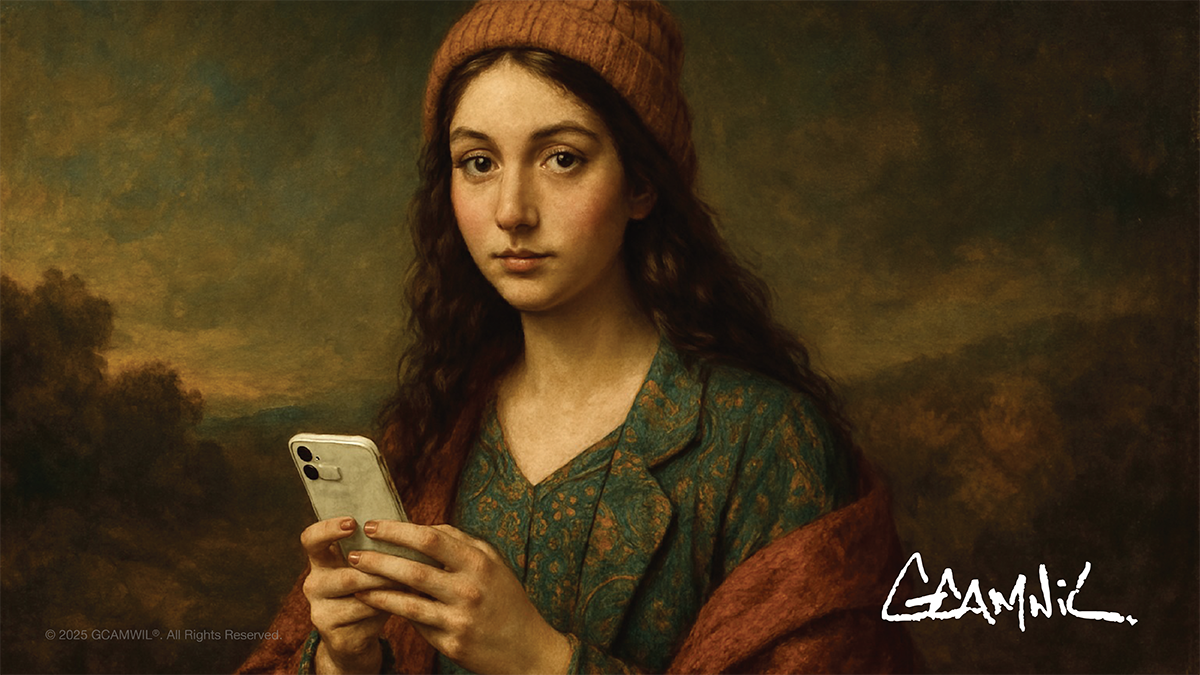
For several years, I’ve carried the quiet feeling that something fundamental has changed.
Not simply that technology is moving faster or that new industries are appearing more frequently than before. Something underneath all of that feels different. Things that would’ve seemed extraordinary ten years ago now become ordinary almost overnight. New tools appear, people adapt, industries reorganize, and before we’ve fully understood one change, another has already begun.
There was never a single moment when the world suddenly became different. The transformation arrived gradually, through thousands of small observations that seemed ordinary enough on their own. Only in hindsight did they begin to look like pieces of the same larger pattern.
I don’t think I arrived at this way of seeing all at once either.
Looking back, I realize I’ve spent much of my life learning to notice relationships that are easy to overlook. My earliest training as an artist taught me that seeing something and understanding what you’re looking at aren’t necessarily the same thing. When you learn to draw, you gradually stop drawing what you assume is there and start paying closer attention to what’s actually in front of you: proportion, negative space, the relationship between one form and another, the structure holding the whole image together.
Long before I had language for the larger ideas explored in this essay, I was learning something simpler.
Understanding often begins with perception.
We notice that something is there before we fully understand what it means.
Later, after the 2008 financial crisis, I moved from fine art into marketing and entrepreneurship. The subject changed, but strangely, the way I looked at things didn’t. Instead of studying drawings, I was studying businesses, audiences, technologies, and human behavior. Instead of looking for composition, I was trying to understand the systems underneath what I could see: why certain ideas spread, why some organizations adapted while others struggled, and why entire industries could begin changing before most people had language for what was happening.
For a long time, I didn’t know what connected these pursuits. Art, design, marketing, entrepreneurship, education, systems, and writing seemed to belong to different chapters of my life.
Eventually, I realized I’d been following variations of the same question:
What are the patterns beneath visible change?
That question taught me something I’ve never really stopped thinking about.
Meaningful change is rarely announced. It accumulates quietly until an entirely new reality has already begun to emerge.
The Feeling We Can’t Quite Explain
That’s how the present feels to me.
Artificial intelligence now performs work that once seemed uniquely human. Individuals can build audiences that rival established media organizations. Information is everywhere, and knowledge is increasingly accessible, yet understanding, judgment, and wisdom still have to be developed. Entire industries can emerge within a few years. Careers that once promised stability now keep evolving.
None of these developments is especially surprising on its own.
What interests me is that they all seem to be moving in the same direction.
More Than a Technological Revolution
Most conversations understandably focus on the technology. We talk about artificial intelligence, the creator economy, remote work, digital education, social platforms, and entrepreneurship as though they’re separate stories. But the more closely I looked, the less separate they appeared.
Technology may be the most visible layer of what’s changing, but it isn’t the whole story.
Underneath it, our assumptions about creativity, learning, ownership, communication, work, and value are changing too. New tools change what an individual can do. Greater access changes who gets to participate. New ways of creating, learning, organizing, and contributing change our relationship with institutions that once served as the primary gateways into those activities.
Seen this way, the branches begin to reveal the roots.
And once I started seeing those connections, it became harder to dismiss them as coincidence. Eventually, I stopped asking whether these changes were related and began asking a much larger question:
What if they belong to the same historical movement?
That question changed the scale of everything.
Every Civilization Has Turning Points
We tend to imagine history as a sequence of clearly defined periods because that’s how we encounter it afterward. Names are assigned. Dates are organized. Turning points become obvious.
But nobody actually lives through history that way.
People still wake up in the morning. They go to work. They raise families. They learn new tools. Businesses open and close. Institutions adapt. Old assumptions become a little less reliable. New behaviors become normal. Life continues while, underneath it, the conditions organizing that life slowly change.
Only later does the pattern become obvious.
There are periods when enough of those changes begin happening together that something larger starts to shift. Technology changes alongside economics. Institutions respond. Culture adapts. Ideas that once seemed like common sense stop explaining the world quite as well as they used to, while whatever comes next hasn’t fully taken shape.
Living inside that kind of transition can feel strange precisely because the old world hasn’t disappeared.
The world remains recognizable, but it no longer behaves in quite the same way.
I suspect that’s part of the tension many people feel now. We’re surrounded by extraordinary possibilities, yet some of the assumptions that guided previous generations no longer feel entirely sufficient. We can sense that something important is happening without necessarily knowing what to call it.
This essay begins with that feeling because I think it deserves to be taken seriously.
It isn’t an argument against technology, and it isn’t an attempt to celebrate every new development simply because it’s new. It’s an invitation to look more carefully at the age we happen to be living through.
My belief is that many of the changes we usually discuss as separate stories are better understood as different expressions of something larger.
Before we decide how to build, create, learn, or contribute within that changing reality, we first have to learn how to see it.
And once we begin to see it, another question follows naturally:
What else might we need to learn to see differently?
Reframing the Change
From the Industrial Age to the Digital Renaissance
Once I began viewing these changes as part of a larger historical transition, another question emerged:
What kind of transition are we actually living through?
History offers a useful place to begin.
Civilizations don’t simply accumulate new inventions. They reorganize themselves around the new conditions those inventions create.
Agriculture didn’t matter only because people developed better ways to produce food. It changed where people lived, how communities formed, how labor was organized, and what societies were capable of building. The Industrial Age wasn’t defined by the steam engine or the factory alone. What mattered was the world that formed around them: mass production, expanding cities, new forms of work, new institutions, and entirely different ways of organizing economic life.
The technology was visible.
The deeper transformation was the civilization reorganizing around it.
Something similar happened as industrial civilization became increasingly information-based. The Industrial Age dramatically expanded our ability to produce and distribute things at scale. The Information Age dramatically expanded access to knowledge, communication, markets, media, and one another.
What appears to be emerging now builds upon both.
Production still matters.
Access still matters.
But increasingly, the defining possibility is creation.
More people can take what they know, what they’ve experienced, what they can imagine, and what they’re capable of doing and turn it into something that can be shared, taught, owned, exchanged, or built upon.
That’s one of the reasons I’ve come to think of the present as a Digital Renaissance.
Artificial intelligence, digital communication, global networks, and widespread access to information matter enormously. But their deeper significance isn’t simply that the technologies are impressive. It’s what they allow more people to do.
Barriers that once separated individuals from publishing, education, entrepreneurship, collaboration, ownership, and large-scale creation have weakened. Work that once required access to a major institution can increasingly begin with one person, a useful idea, and the ability to develop it.
That doesn’t make institutions obsolete. And it certainly doesn’t mean opportunity is now distributed equally.
It means the relationship is changing.
The Convergence of Great Forces
More people can participate in activities that previous generations often encountered primarily as consumers. They can learn directly, publish independently, build businesses, develop intellectual property, reach audiences, collaborate across borders, and create forms of value that would’ve once required far more permission, capital, or institutional access.
And creation is only one part of the pattern.
Education changes when knowledge becomes easier to access. Work changes when machines become capable of doing more alongside us. Media changes when individuals can communicate directly with audiences. Economics changes when knowledge, trust, relationships, creativity, and intellectual property can become productive assets. Institutions change when people gain tools that allow them to perform some functions independently that once required centralized systems.
These changes don’t sit neatly beside one another.
They interact.
Technology changes work. Changes in work affect what people need to learn. Learning changes capability. Greater capability creates new forms of economic participation. Those forms of participation place new pressure on institutions. Institutions adapt, culture responds, expectations change, and those expectations influence what individuals believe is possible.
The loop keeps moving.
Civilizations rarely change one institution at a time. They change when many independent systems begin moving in the same direction.
That’s the convergence that interests me most.
I encountered fragments of it for years without fully understanding what I was looking at. Because my own work kept crossing between art, marketing, entrepreneurship, education, and systems, I was often seeing the same forces from different sides. What looked like a change in media from one angle appeared as a change in business from another. A change in technology became a change in education. A change in access became a change in ownership.
The boundaries between these subjects became less useful because the forces reshaping them didn’t respect those boundaries in the first place.
Once those relationships become visible, the individual headlines begin to matter less than the pattern connecting them.
Why Old Mental Models No Longer Explain the Present
But there’s another reason periods like this are difficult to understand.
The old world doesn’t disappear when the new one begins.
People continue working inside institutions built for earlier conditions. Familiar career paths still exist even as they become less predictable. Skills that once remained valuable for decades need to be renewed more often. Old assumptions can still contain enormous wisdom while becoming less capable of explaining everything around us.
For a while, both realities exist at once.
We find ourselves living between two coherent stories, belonging completely to neither.
That can become disorienting.
When a familiar path stops producing familiar results, it’s natural to wonder whether we’ve fallen behind, chosen incorrectly, or failed to adapt quickly enough. Sometimes that’s exactly what happened.
But not always.
Sometimes confusion belongs partly to the map.
An outdated map can make a capable traveler feel lost.
The traveler may still know how to move. The destination may still be worth reaching. But if the roads have changed, walking faster won’t necessarily help.
We already have more information than any previous generation could’ve imagined. More information alone won’t solve that problem. What we need is a better way of understanding the terrain: a way to recognize which changes belong together, which assumptions still describe reality, and which ones were shaped by conditions that no longer exist in quite the same form.
That’s why historical perspective matters.
It gives us enough distance to reconsider the map without assuming everything on it was wrong.
I don’t see this as a rejection of the past. Every civilization inherits wisdom from what came before it. Many of the principles that helped previous generations build meaningful lives, strong institutions, useful knowledge, and functioning societies remain just as important now.
The harder task is learning to distinguish those enduring principles from the assumptions that formed around a particular moment in history.
The present asks something more demanding of us than simply keeping pace with technology.
It asks us to improve the lens through which we interpret change itself.
Because once the pattern becomes visible, a more difficult question follows:
Which of our assumptions still belong to the world that produced them, and which principles will remain useful in the world now taking shape?
Seeing the Pattern
Changing the Lens
One of the most valuable lessons I’ve learned is that confusion often has less to do with missing information than with the way we’re organizing what we already know.
I’ve experienced this repeatedly in my own work. There were periods when I thought I was managing a growing collection of unrelated projects: courses, essays, operating systems, educational frameworks, businesses. Each seemed to belong in its own category, which made the whole thing feel increasingly complicated.
Then I began seeing them differently.
They weren’t separate projects competing for space. They were different expressions of the same larger philosophy.
Nothing about the projects themselves had changed. Their relationship to one another had.
And once I could see that relationship, decisions that had previously felt complicated became much easier to make.
That experience taught me something I’ve returned to many times since: sometimes understanding doesn’t begin with discovering a new fact. It begins with seeing familiar facts in a different relationship.
The information may have been there all along.
What changes is the lens.
The same principle applies to the world around us.
Reality rarely becomes incomprehensible overnight. More often, the explanations we’ve relied upon gradually stop explaining everything we’re seeing. We continue using them because they worked before, and often because they still contain something useful.
That’s what mental models are for. They simplify complexity so we can navigate it.
But the map has to remain accountable to the terrain.
When conditions change, our models sometimes have to change with them.
This is why accumulating more information isn’t always enough.
We already live inside an extraordinary abundance of it. We can follow technological developments almost as they happen, study industries anywhere in the world, access generations of accumulated knowledge, and encounter more perspectives in a day than previous generations might have encountered in years.
Access is no longer the whole problem.
Understanding requires us to see relationships.
I noticed this change in my own research gradually. I became less interested in asking which technology mattered most or what had happened that day. I became more interested in what those developments revealed.
Why were changes in technology, education, creativity, economics, ownership, and institutions appearing at the same time?
Which boundaries were becoming easier to cross?
Which assumptions were becoming less reliable?
What was the pattern underneath all of it?
The better my questions became, the more coherent the picture became.
The Digital Renaissance
Eventually, I needed language for what I thought I was seeing.
I came to think of it as the Digital Renaissance.
I use digital because digital infrastructure now sits beneath so much of this transformation. It allows knowledge, communication, creation, collaboration, and economic activity to move across boundaries at a scale that would’ve been difficult to imagine not long ago.
But renaissance is the more important part of the phrase.
Because the deeper story is human.
The historical Renaissance wasn’t significant simply because new tools appeared. It was a period in which changes in knowledge, art, communication, commerce, institutions, and human curiosity began interacting in ways that expanded what people could know, create, and imagine.
I don’t think history is repeating itself, and the conditions today are obviously different.
But I do see a structural resemblance.
Once again, expanding access to knowledge and new forms of technology are changing what individuals are capable of doing.
A person sitting at a laptop can now learn from people across the world, publish an idea, build an audience, create a business, collaborate across borders, develop intellectual property, teach what they know, produce media, or build something that reaches people they’ve never met.
None of this guarantees that what they create will be useful, meaningful, or good.
But the capability exists.
And increasingly, it exists for more people.
That’s the part of the Digital Renaissance that interests me most.
Technology is changing rapidly, but technology isn’t the whole story. The deeper transformation is what those technologies make possible for human beings: new ways to learn, create, communicate, own, build, collaborate, and contribute.
Once I began looking at the present this way, many developments that had seemed unrelated started fitting into the same picture.
The Digital Renaissance became useful to me not because it explained everything, but because it helped me see relationships I had previously been looking at separately.
That’s all a lens can really do.
No framework can capture an age in its entirety, especially while that age is still unfolding. Some of the developments that seem important today will prove transformative. Others will disappear. Institutions will adapt at different speeds. New possibilities will create new problems. Predictions will fail.
A useful lens doesn’t eliminate that uncertainty.
It helps us see through it.
The Invitation to Continue
For me, the Digital Renaissance changed the question from:
What does this new development do?
to something larger:
What does this reveal about the direction civilization is moving?
And that changes the questions that follow.
If knowledge is increasingly accessible, what should education actually develop?
If technology keeps changing what machines can do, which human capabilities become more important?
If more people can create and distribute their own work, what does that change about creativity and ownership?
If individuals can perform functions that once required institutional scale, how does the relationship between individuals and institutions evolve?
These questions don’t tell us what to think.
They help us see what may need to be reconsidered.
That’s an important distinction.
Recognizing the Digital Renaissance is only the beginning. A historical lens can help explain why the world feels different, but it can’t decide how we should respond. Nor should it.
The purpose of seeing more clearly isn’t to replace uncertainty with certainty.
It’s to become better at asking questions that correspond to reality.
The world will keep changing. New technologies will appear. Industries will reorganize. Institutions will adapt. Some predictions will look obvious in hindsight, while others will be forgotten almost as quickly as they were made.
We don’t need a perfect explanation of the future.
We need to learn how to see the present clearly enough to think about it well.
And once we begin seeing the present through that lens, a different set of questions becomes difficult to avoid:
Which assumptions still correspond to reality? Which belong primarily to the conditions that produced them? And what principles remain useful when the conditions themselves continue to change?
The Digital Renaissance
Perhaps some of what has felt confusing about the present looks different now.
Changes that once seemed unrelated may begin to look connected. Questions that felt entirely personal may have a historical dimension. Things that once appeared permanent may look more temporary than they did before.
Maybe you noticed some of this long before you had language for it.
Perhaps a career path that once seemed predictable became harder to read. You learned something important from someone thousands of miles away without ever entering a classroom. A tool suddenly allowed you to do something that would’ve required a team only a few years earlier. Or an interest that once seemed disconnected from the rest of your life became unexpectedly useful.
Maybe nothing dramatic happened at all.
You simply began to notice that paths once considered unusual were becoming ordinary.
These experiences don’t prove that the Digital Renaissance is the only way to understand the present. Nor do you need to agree with every conclusion in these pages for the lens to be useful.
A framework earns its place by helping us see more clearly.
It doesn’t need our loyalty.
It needs to remain accountable to reality.
So look at the world you actually inhabit.
Notice how you learn. How you communicate. How you develop skills. How you create. How you work. Notice which capabilities you now take for granted that would’ve seemed extraordinary not very long ago.
Then look at your own path.
What if some of the experiences you’ve treated as disconnected are more connected than they appear?
What if some of the uncertainty you’ve felt isn’t only about your ability to navigate, but about whether the map you’re carrying still matches the terrain?
That doesn’t mean every old assumption is wrong. It doesn’t mean every unfamiliar path is better. And it doesn’t mean changing conditions remove our responsibility for the choices we make.
It simply means the conditions themselves deserve to be examined.
Before deciding that we’ve failed to navigate the world well, it’s worth asking whether the world we’re navigating has changed.
There is no need to answer that question yet.
For now, it’s enough to notice it.
The world may not look different when you close this page.
But perhaps you’ll notice different things within it.
Continuing the Conversation
Once these changes are seen together, they become difficult to treat as separate developments.
The world hasn’t simply gained new technologies. The conditions surrounding how we learn, create, work, communicate, own, and participate are changing with them.
Seeing that pattern doesn’t tell us what the future will become.
But it gives us a clearer view of the present.
And recognition creates a problem of its own.
The world can change faster than the assumptions we inherit about how it works.
Many of the ideas we’ve inherited about work, education, creativity, ownership, authority, value, and opportunity were shaped under different conditions. That doesn’t make them wrong. Some contain principles worth preserving precisely because they’ve survived changing circumstances.
But an assumption that made sense under one set of conditions doesn’t automatically remain complete under another.
If the conditions change while the assumptions remain fixed, eventually the two stop describing the same world.
That’s why periods of transition require more than learning how to use new tools. They require us to look beneath the tools and ask what remains true when the circumstances around them change.
Technologies will keep evolving. Industries will appear and disappear. Institutions will adapt. Skills that matter today may matter differently tomorrow. Platforms and opportunities will come and go.
A philosophy built entirely around present circumstances will age with them.
So the deeper question is what remains true beneath the change.
Which of our assumptions still correspond to reality?
Which belong more closely to the conditions that produced them?
And which principles remain useful even as those conditions continue to change?
Recognition alone can’t answer those questions.
It can only make them difficult to ignore.
That’s where interpretation begins.
Garett
PS: Know someone who would benefit from this? Send them this link → subscribe.garettcampbellwilson.com
Want more insights on mastering the creator economy? Follow me on Instagram @gcamwil and stay updated on the latest strategies.
The Digital Renaissance Starts Here
You just read the opening chapter of the Digital Renaissance Manifesto.
This isn’t a trend piece. It’s a map. One designed for creators, builders, and founders navigating the collapse of the old system—and rising into something more sovereign, more aligned, and more free.
Part 1 showed you why the system no longer works, what’s replacing it, and how to reclaim your creativity as leverage.
Next up: Part 2.
We go deeper into how the architecture of freedom is built—from monetization to mindset to the mechanics of leverage.
→ Read Part 2 of the Digital Renaissance Manifesto
Keep Learning: Related Reads
- THE 9 TO 5 IS DEAD. NOW WHAT?: Why some are waking up to the fact that relying on a single employer for financial security is too risky.
- HOW TO START EARNING AS A CREATOR: The exact steps to go from posting content to making money.
- YOU DON’T NEED EVERY TOOL. JUST THESE.: Cut through the noise and use only what actually matters.